
The Best Tool to Learn about Italian Wine

italian wine regions - quattrocalici

Tuscany - Appellations of Origin

Tuscany's Denominations of Origin

Wine Appellations of Tuscany

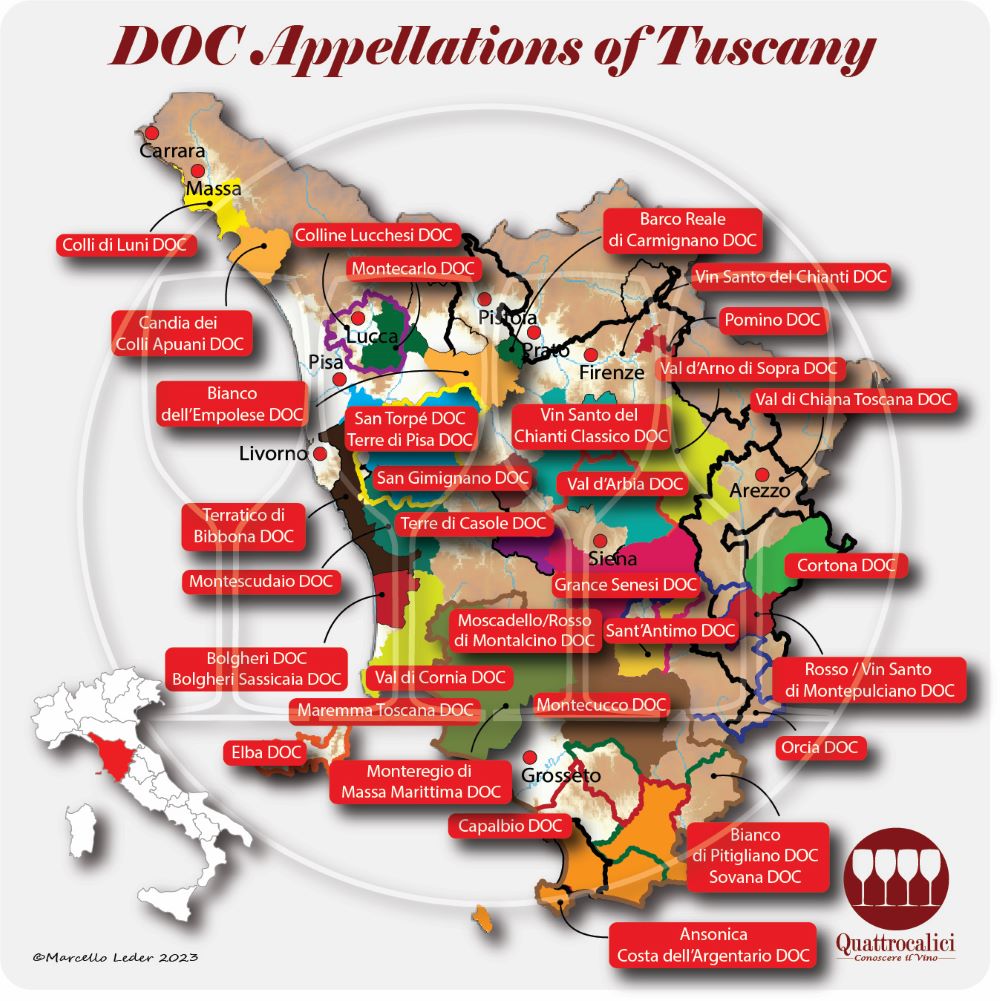
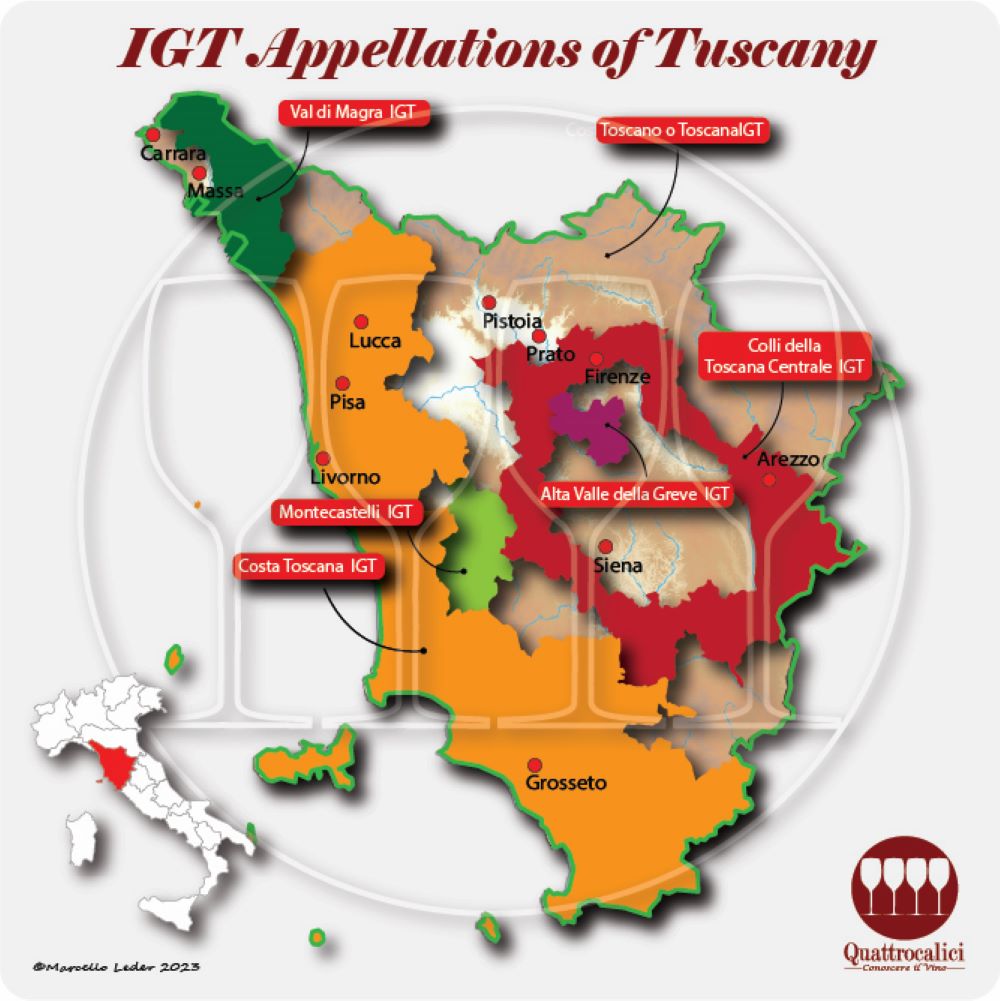
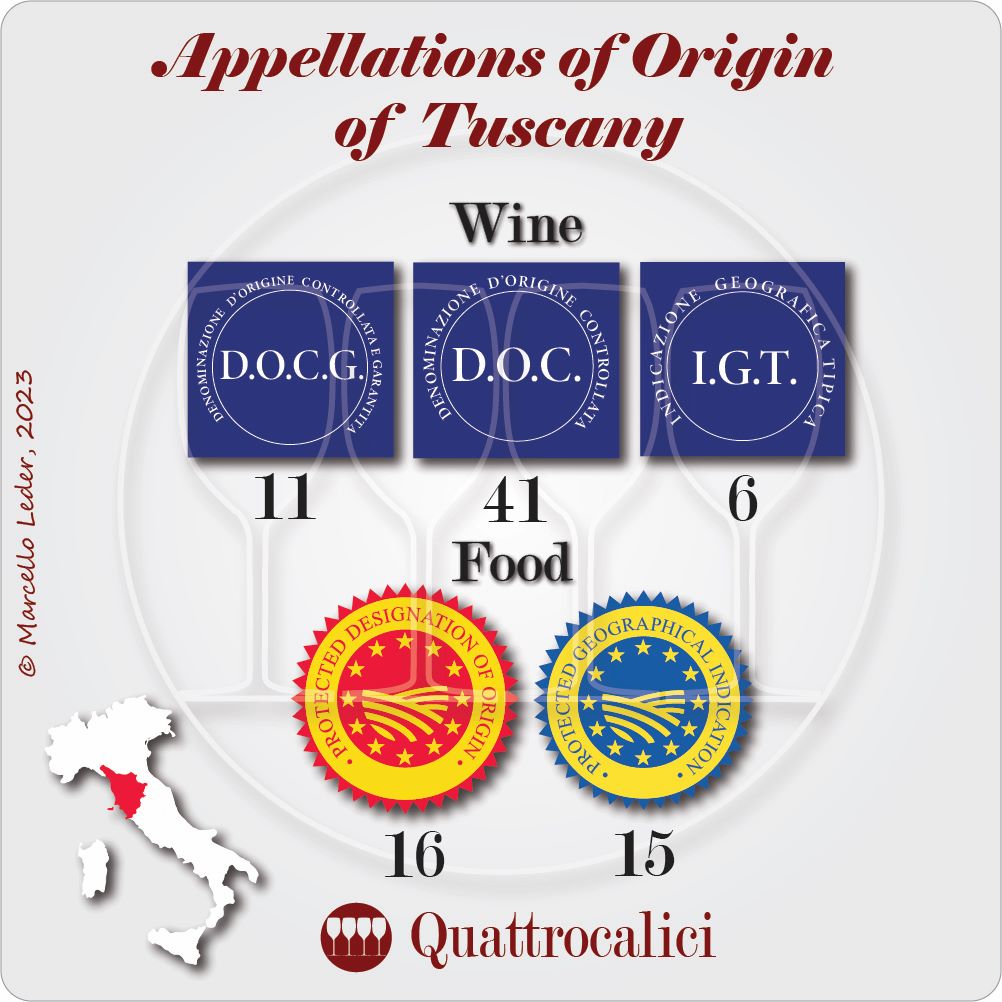
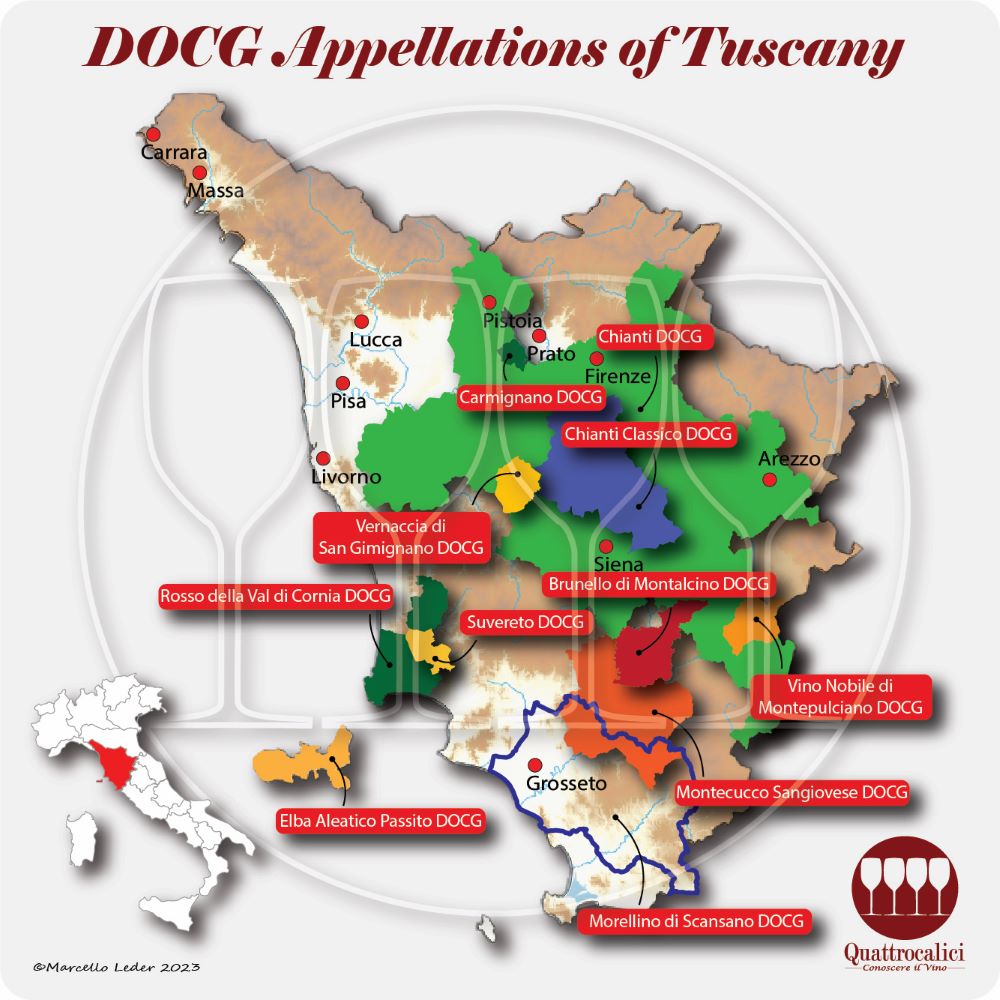
Tuscany is one of Italy’s most important wine-producing regions. As such, the number of Designations of Origin DOCG and DOC present in its territory is considerable (11 DOCG and 41 DOC, in addition to 6 IGT). The Chianti area alone includes two DOCGs: Chianti Classico DOCG, the traditional area between Florence and Siena, and Chianti DOCG, which encompasses a vast area across all Tuscan provinces except Massa-Carrara, Grosseto, and Livorno, and includes 7 subzones at the provincial extension: Colli Aretini, Colli Fiorentini, Colli Senesi, Colline Pisane, Montalbano, Montespertoli, and Rufina. In the Siena area, near Montalcino, we find Brunello di Montalcino DOCG (pure Sangiovese, locally called Brunello), but also Carmignano DOCG (minimum 50% Sangiovese, max 20% Canaiolo, 10-20% Merlot and Cabernet, alone or together). There’s also Vernaccia di San Gimignano DOCG (a white wine, produced from the grape of the same name) and further down Val di Chiana DOC and Vino Nobile di Montepulciano DOCG (Sangiovese, locally called Prugnolo gentile). In the area, there are also 15 DOCs, among which it’s worth mentioning the three DOCs of Vin Santo corresponding to the respective DOCGs for dry red wines (Vin Santo del Chianti DOC, Vin Santo del Chianti Classico DOC, and Vin Santo di Montepulciano DOC). On the border with Liguria, the interregional DOC Colli di Luni DOC (in the area known as Lunigiana), where Vermentino is the most widespread white grape variety. Further down, below the Apuan Alps, is the Candia area (with the denomination Candia dei Colli Apuani DOC) and its white wines based on Vermentino and red wines based on Sangiovese and Merlot. There is also a type of wine, Vermentino Nero, a red wine based on the grape of the same name. In the Lucca area, the denomination Colline Lucchesi DOC and Montecarlo DOC, characterized by both red and white grape varieties of French origin (Syrah for red wines, Semillon, Sauvignon, and Roussanne for white wines). In the province of Livorno, not far from the coast, the Bolgheri area is famous for wines known as supertuscans (in the DOC Bolgheri and Bolgheri Sassicaia DOC, the latter dedicated exclusively to the most famous wine of this type). The recent Suvereto DOCG, formerly a subzone of the DOC Val di Cornia, was later also elevated to DOCG (Rosso della Val di Cornia DOCG). The Isola d’Elba, with the Elba DOC, is characterized by Aleatico (red) and Ansonica (white) and Trebbiano grapes, here known as Procanico. Finally, in the Grosseto area, we have 8 DOCs, among which Ansonica Costa dell’Argentario DOC and Morellino di Scansano DOCG stand out, with its pure Sangiovese wines, locally called Morellino.

The Appellations of Origin in Tuscany

Wine Appellations of origin in Tuscany

The following maps feature the borders of the Wine Appellation of origin in the administrative region of Tuscany

DOCG Appellations of Tuscany

Tuscany's Wine DOCG Appellations
AppellationDistricts
Brunello di Montalcino DOCGSiena
Carmignano DOCGPrato
Chianti Classico DOCGFirenze, Siena
Chianti DOCGArezzo, Firenze, Siena, Pisa, Pistoia, Prato
Elba Aleatico Passito o Aleatico Passito dell’Elba DOCGLivorno
Montecucco Sangiovese DOCGGrosseto
Morellino di Scansano DOCGGrosseto
Rosso della Val di Cornia DOCGLivorno, Pisa
Suvereto DOCGLivorno
Vernaccia di San Gimignano DOCGSiena
Vino Nobile di Montepulciano DOCGSiena

DOC Appellations of Tuscany

Tuscany's Wine DOC Appellations
AppellationDistricts
Ansonica Costa dell’Argentario DOCGrosseto
Barco Reale di Carmignano DOCPrato
Bianco dell’Empolese DOCFirenze
Bianco di Pitigliano DOCGrosseto
Bolgheri DOCLivorno
Bolgheri Sassicaia DOCLivorno
Candia dei Colli Apuani DOCMassa-Carrara
Capalbio DOCGrosseto
Colli dell’Etruria Centrale DOCFirenze, Siena, Pisa, Pistoia, Prato, Arezzo
Colli di Luni DOCLa Spezia, Massa-Carrara
Colline Lucchesi DOCLucca
Cortona DOCArezzo
Elba DOCLivorno
Grance Senesi DOCSiena
Maremma Toscana DOCGrosseto
Montecarlo DOCLucca
Montecucco DOCGrosseto
Monteregio di Massa Marittima DOCGrosseto
Montescudaio DOCPisa
Moscadello di Montalcino DOCSiena
Orcia DOCSiena
Parrina DOCGrosseto
Pomino DOCFirenze
Rosso di Montalcino DOCSiena
Rosso di Montepulciano DOCSiena
San Gimignano DOCSiena
San Torpè DOCPisa, Livorno
Sant’Antimo DOCSiena
Sovana DOCGrosseto
Terratico di Bibbona DOCLivorno
Terre di Casole DOCSiena
Terre di Pisa DOCPisa
Val d’Arbia DOCSiena
Val d’Arno di Sopra DOCArezzo
Val di Cornia DOCLivorno, Pisa
Valdichiana Toscana DOCArezzo, Siena
Valdinievole DOCPistoia
Vin Santo del Chianti Classico DOCFirenze, Siena
Vin Santo del Chianti DOCFirenze, Siena, Pisa, Pistoia, Prato, Arezzo
Vin Santo di Carmignano DOCPrato
Vin Santo di Montepulciano DOCSiena

IGT Appellations of Tuscany

AppellationDistricts
Alta Valle della Greve IGTFirenze
Colli della Toscana Centrale IGTFirenze, Arezzo, Pistoia, Prato, Siena
Costa Toscana IGTMassa-Carrara, Lucca, Pisa, Livorno, Grosseto
Montecastelli IGTPisa
Toscano o Toscana IGTArezzo, Firenze, Grosseto, Livorno, Lucca, Massa-Carrara, Pisa, Pistoia, Prato, Siena
Val di Magra IGTMassa-Carrara

Agrifood Appellations of Origin in Tuscany

Tuscany’s agricultural food product designations include products based on meat (6 denominations) and fresh meats (3 denominations), in the cheese sector (3 denominations), bakery and pastry (4 denominations), extra virgin olive oil (5 denominations), and fruit and vegetables and cereals (8 denominations). Tuscany thus confirms itself by far as the leading Italian region in terms of the number of origin designations for agricultural food products and is also first in terms of certified cultivated area. In total, we are talking about 31 PDO and PGI products.

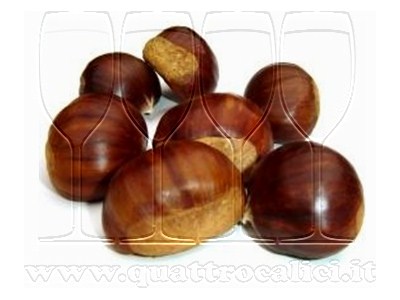
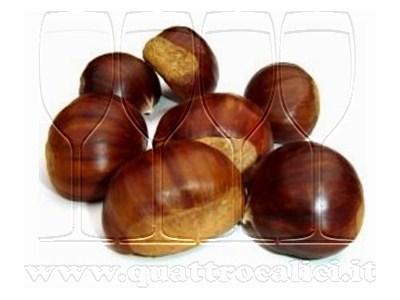
Many denominations are dedicated to chestnuts. In Upper Tuscany, on Monte Amiata, the PGI chestnut is perfect for boiling or roasting, or for making into polenta or Castagnaccio. In Garfagnana, we find the flour of neccio and in Lunigiana, the chestnut flour. In Mugello, on the other hand, the Marrone del Mugello PGI is cultivated; in Caprese Michelangelo, in the enchanting Valtiberina, the Marrone DOP.

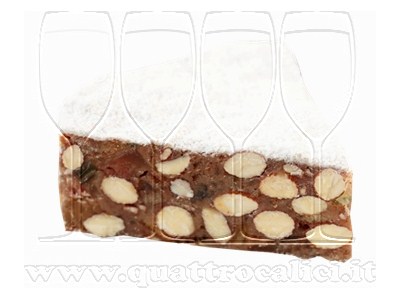
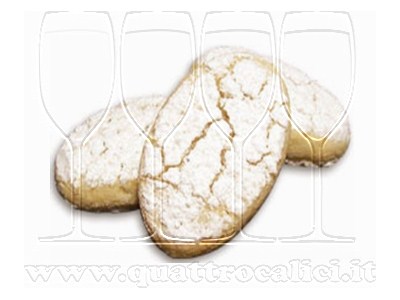
Among the denominations dedicated to spices, the San Gimignano PDO saffron stands out in Tuscany, while Ricciarelli PGI and Panforte PGI are made in Siena. The Cantucci PGI, also from Tuscany, are to be enjoyed with a glass of Vinsanto.

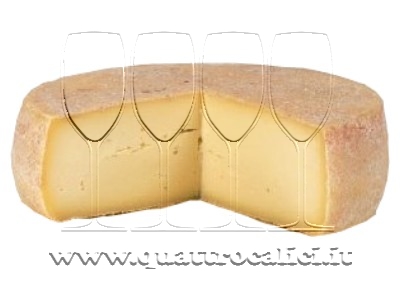
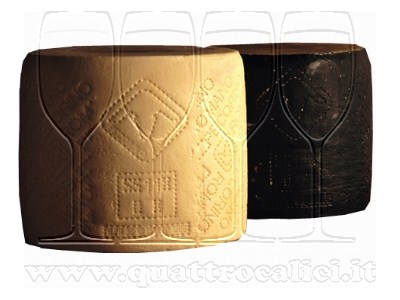
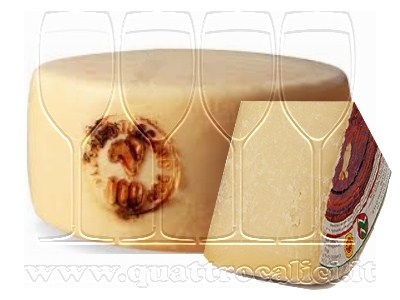
Among the cheeses, Pecorino Toscano PDO is widespread throughout Tuscany, while Pecorino Romano PDO has an area that extends into the province of Grosseto. Pecorino delle Balze Volterrane is produced in Volterra and its surroundings.

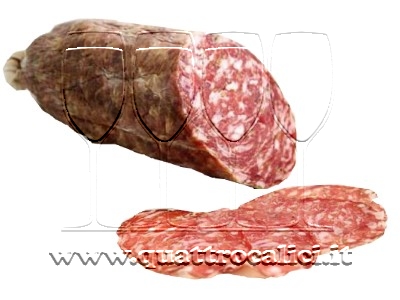
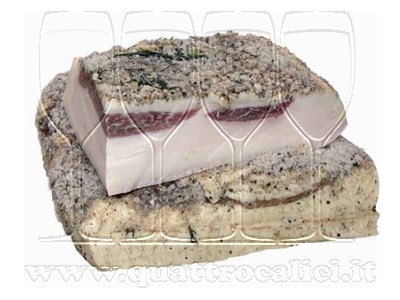
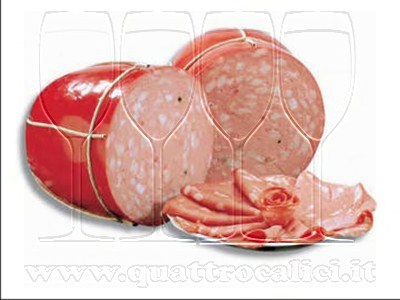
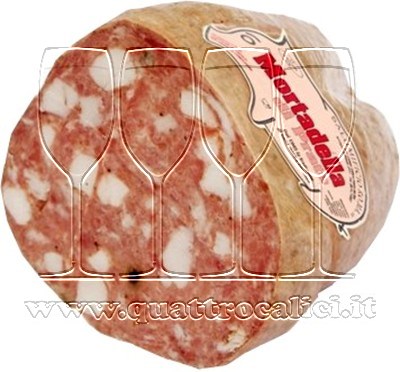
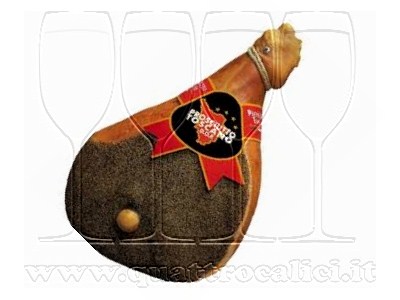
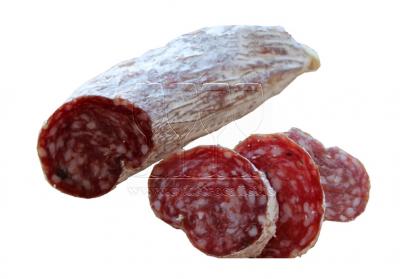
As for cold cuts, we remember Finocchiona PGI, Mortadella di Prato, Prosciutto Toscano PDO, Lardo di Colonnata PGI, and the ubiquitous Salamini Italiani alla Cacciatora PDO.

In Tuscany, extra virgin olive oil is produced, including Toscano PGI, Chianti Classico PDO, Terre di Siena PDO, Lucca PDO, and Seggiano PDO olive oils.

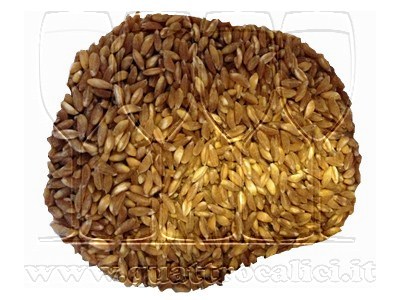
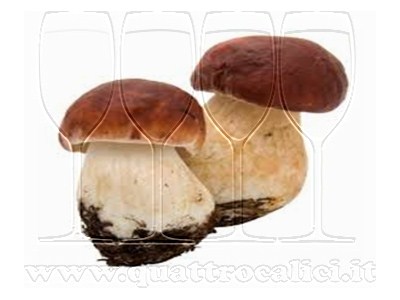
Among the typical cereals, there’s Farro della Garfagnana PGI, while in the heart of Valdinievole, the Sorana PGI bean is cultivated. The Borgotaro PGI mushroom comes from the province of Massa Carrara, from where also comes the Lunigiana PDO honey.

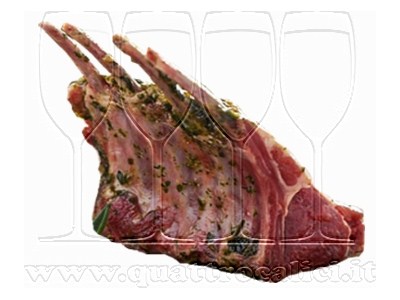
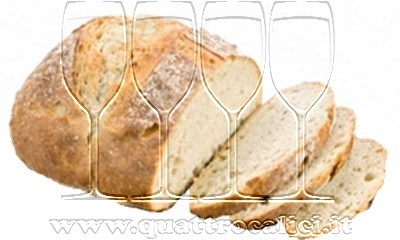
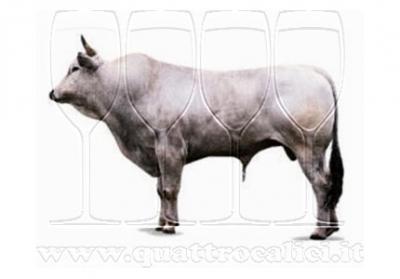
Typical meats of Tuscany include Cinta Senese PDO, Vitellone Bianco dell’Appennino Centrale PGI, and Central Italy Lamb PGI, and finally, we remember the Tuscan Bread PDO, characteristic for being completely salt-free.

Agrifood Appellations of Origin of Tuscany

AppellationAppellation classCategory
Agnello del Centro Italia IGPPGIMeat
Castagna del Monte Amiata IGPPGIFruits
Chianti Classico DOPDOPOil and olives
Cinta Senese DOPDOPMeat
Fagiolo di Sorana IGPPGIGreens and vegetables
Farina di Castagne della Lunigiana DOPDOPFruits
Farina di Neccio della Garfagnana DOPDOPFruits
Farro della Garfagnana IGPPGICereals
Finocchiona IGPPGICured meats
Fungo di Borgotaro IGPPGIMushrooms
Lardo di Colonnata IGPPGICured meats
Lucca DOPDOPOil and olives
Marrone del Mugello IGPPGIFruits
Marrone di Caprese Michelangelo DOPDOPFruits
Miele della Lunigiana DOPDOPHoney
Mortadella Bologna IGPPGICured meats
Mortadella di Prato IGPPGICured meats
Pane Toscano DOPDOPBread
Panforte di Siena IGPPGISweets
Pecorino delle Balze Volterrane DOPDOPCheese
Pecorino Romano DOPDOPCheese
Pecorino Toscano DOPDOPCheese
Prosciutto Toscano DOPDOPCured meats
Ricciarelli di Siena IGPPGISweets
Salamini Italiani alla Cacciatora DOPDOPCured meats
Seggiano DOPDOPOil and olives
Terre di Siena DOPDOPOil and olives
Toscano IGPPGIOil and olives
Vitellone Bianco dell’Appennino Centrale IGPPGIMeat
Zafferano di San Gimignano DOPDOPSpices

Quattrocalici Wine Guide