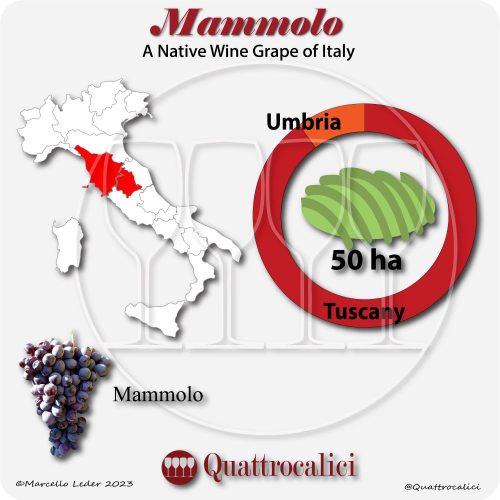



The Mammolo grape variety is a black-berried variety cultivated in central Italy. Although it is no longer widely grown today, Mammolo is one of the historically most prevalent grape varieties in Tuscan viticulture. In fact, at the end of the 17th century, the botanist Micheli, in his work “Istoria delle Viti,” described various biotypes cultivated in Tuscany, including Mammolo Nero, Rosso, Sgrigliolante, and Piccolo Rosso Nero. During the same period, Bartolomeo Bimbi painted it in his panels dedicated to the grapes cultivated in the Medici villas. In 1877, Di Rovasenda mentioned various types, including Mammolone, which appears to have been cultivated in the Lucca area. Its distinctive name is thought to derive from the characteristic violet aroma that distinguishes the wine made from it.
Present also in Chianti, alongside Sangiovese and Canaiolo, Mammolo is still sporadically found in old Tuscan vineyards and is also an integral part of the traditional blend for Vino Nobile di Montepulciano. It is also found in many IGT wines in both Umbria and Tuscany, but it does not explicitly appear in any DOP denomination regulations. Recent genetic studies conducted in France have established that Mammolo and Sciaccarello, widespread in Corsica, are identical, and the Tuscan origin of the grape variety has been acknowledged by the French. In Corsica, it is also known by the synonym Muntanaccia and is cultivated on about 700 hectares, producing red wines but especially rosés, which are not very structured but have great aromatic complexity. The late ripening of Mammolo and the low color intensity of its wine make it less interesting for modern vinification styles, which do not highlight the freshness of its aromas and the typicity of its wines.
From an ampelographic point of view, Mammolo has a medium-sized, pentagonal, deeply five-lobed leaf. Its cluster is medium, truncated-conical, moderately compact, winged, with large, round, violet-colored berries even when fully ripe.