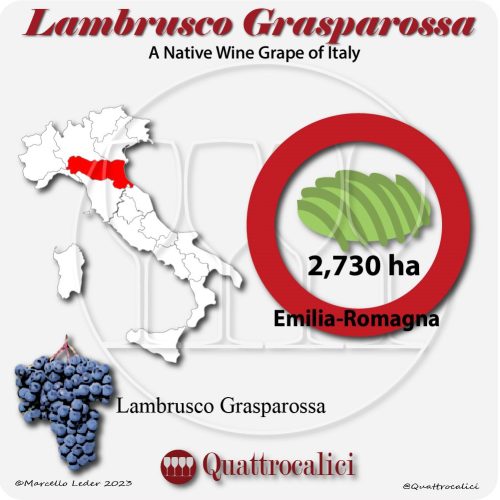


The Lambrusco Grasparossa grape variety, like the other varieties in the Lambrusco family, likely has wild origins (vitis silvestris or vitis labrusca, as also mentioned by Pliny the Elder) and was later domesticated. It is a grape variety widely cultivated in the provinces of Modena and Mantua. There are two different zones: one is hilly, and the other is sub-hilly. In the first zone, the soil is not easy to cultivate but results in higher quality wines, partly due to yields below the average. In the second zone, the yields are more abundant, with lower quality but also different organoleptic properties. Lambrusco Grasparossa gets its name from the particular characteristic that in autumn, the rachis and pedicels turn red, a phenomenon that contributes to the particularly striking colors of the vineyards in these areas during the harvest.
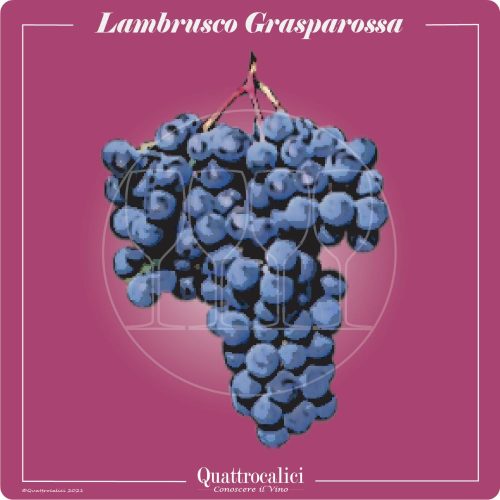
The grape variety has a late maturation, so it makes use of the last rays of sunshine before winter. Lambrusco Grasparossa has medium-sized and lengthened, loose, conical clusters. The berries are spherical, medium-sized with abundant bloom, thick and leathery skins of blue tending towards black. Lambrusco Grasparossa is vinified both as a pure variety and in blends with other Lambrusco varieties, also due to its low productivity. It is also blended with Fortana and Malbo Gentile, but always as the predominant grape variety. Like all Lambrusco wines, Lambrusco Grasparossa produces sparkling or semi-sparkling wines using the Charmat method. Starting in the 1990s, there has been a revision of processing methods to reduce sweetness and make the wine drier and more elegant. Lambrusco Grasparossa yields wines with a ruby color with violet hues, reflected even in the foam, a fruity, fresh olfactory range with hints of grapes and almonds. On the palate, the wine is well-balanced between freshness and sapidity, with moderate acidity and a slightly bitter and well-structured finish. It is ideal to accompany meat-based first courses, baked pasta, roasts, as well as cured meats and cheeses. In its amabile (semi-sweet) version, it can be paired with dry pastries.