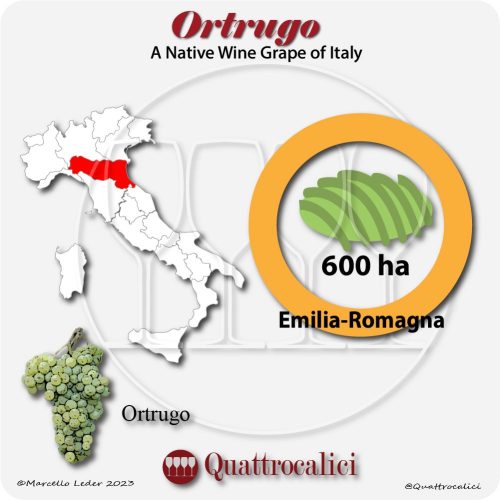


Ortrugo is a white grape variety predominantly cultivated in Emilia, specifically in the province of Piacenza. Until the mid-1970s, Ortrugo was primarily used as a blending grape. However, during that period, some producers began selecting old vines to produce a pure Ortrugo wine. This led to the development of two new clones of Ortrugo, in collaboration with the University of Piacenza. From the 1980s onward, these clones were replanted throughout the Emilian region. Despite earlier vineyard reductions due to the rise of Malvasia di Candia Aromatica, Ortrugo has become the most widely cultivated grape in the area, even surpassing international varieties.
Pure Ortrugo wine typically appears with a light straw-yellow color, sometimes with greenish tints, and has a dry or semi-sweet flavor, often with a slightly bitter aftertaste. It is usually produced in frizzante (lightly sparkling) or spumante (fully sparkling) styles, though recently, still versions have been introduced to cater to broader consumer tastes.
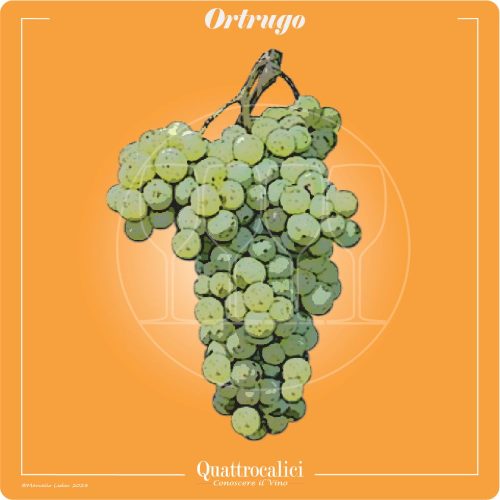
Ampelographically, Ortrugo has large, somewhat kidney-shaped, three-lobed leaves, sometimes five-lobed. The grape clusters are large, cylindrical-conical, often with a wing, elongated, and very compact. The berries are medium-sized, spherical, with a yellow-greenish skin, slightly dotted, and covered with a fine layer of bloom.