


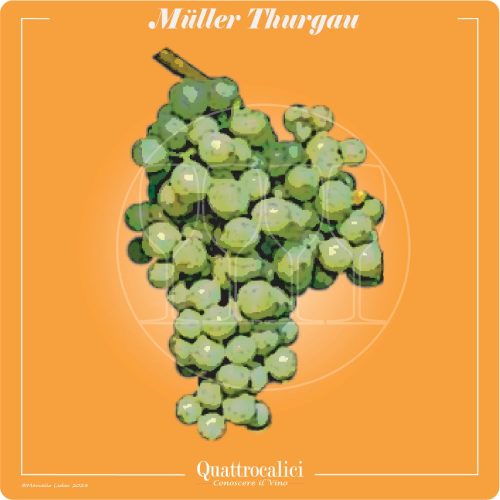
Müller-Thurgau is a widely cultivated white grape variety grown in various wine regions around the world. Its popularity stems from its ability to adapt to different climates and soils, as well as its early ripening.
Origins of Müller-Thurgau
Müller-Thurgau was developed by Professor Hermann Müller, who was born in Thurgau, Switzerland, in 1882 at the Geisenheim Research Center in Germany. It was created by crossing two grape varieties: Riesling and Madeleine Royale.
The first is a highly valued white grape variety known for producing high-quality wines, recognized for its pronounced acidity and aging potential. Riesling originates from the Rhine Valley in Germany. Madeleine Royale is a less known white grape variety, but it was used for its early ripening and resistance to diseases, traits often sought in grape breeding to improve other varieties.
The combination of these two varieties resulted in Müller-Thurgau, which is appreciated for its ability to produce aromatic, fresh, and relatively easy-to-drink wines.
The Precursors of Müller-Thurgau
While Riesling is confirmed as one of its parents, confusion regarding the second parent of Müller-Thurgau has arisen due to historical errors and uncertainties in the grape identification techniques used in the 19th century. Here are some reasons why it was believed that the second parent could be Sylvaner or Chasselas:
- Breeding and Identification Techniques: When Müller-Thurgau was created, the breeding and genetic identification techniques were not as precise as they are today. Initially, Hermann Müller thought he had used Sylvaner as one of the parents, but the DNA analysis techniques available at the time could not confirm the parentage with certainty.
- Morphological Similarities: The physical characteristics of the Müller-Thurgau vines and grapes can resemble those of Sylvaner and Chasselas, leading to incorrect assumptions based on visual observations and organoleptic properties of the wines produced.
- Modern DNA Analysis: Only with the advent of modern DNA analysis techniques was it possible to more accurately determine the genetic lineage of grape varieties. These analyses confirmed that the second parent of Müller-Thurgau is Madeleine Royale, not Sylvaner or Chasselas.
- Historical Transcriptions: There were transcription and interpretation errors in the historical records of the crosses made by Hermann Müller, which led to the spread of inaccurate information.
Global Distribution of Müller-Thurgau
Müller-Thurgau is widely grown in various wine regions around the world. Its popularity is due to its adaptability to different climates and soils, as well as its early ripening. Here’s an overview of its global spread:
- Germany: It is one of the main countries producing Müller-Thurgau, especially in the Mosel, Rheinhessen, Palatinate, and Franconia regions. Germany is one of the largest cultivation areas for this grape variety.
- Austria: Müller-Thurgau is grown in several Austrian wine regions, including Styria and Lower Austria, and is appreciated for producing fresh and aromatic wines.
- Switzerland: As the homeland of Hermann Müller, Switzerland cultivates Müller-Thurgau mainly in the regions of Thurgau and the Grisons.
- Czech Republic and Slovakia: Here, Müller-Thurgau is very popular and is used to produce fresh and aromatic white wines, known locally as “Müllerka.”
- Hungary: Cultivated in the Balaton and Alföld wine regions, where it is known as “Müller-Thurgau” or “Rizlingszilváni.”
- United Kingdom: Although British viticulture is less renowned, Müller-Thurgau is one of the varieties grown to produce fresh and light white wines, suited to the cooler climate of the UK.
- New World: Müller-Thurgau is also cultivated in some New World wine regions, such as the United States (particularly in Oregon and Washington State) and New Zealand. It is appreciated for its adaptability to various climates and its production of aromatic and fresh wines.
- In Italy, it is grown in almost all regions, but it plays a significant role in Trentino-Alto Adige, Friuli-Venezia Giulia, and Veneto. In Alto Adige, Müller-Thurgau is primarily cultivated in the Val di Cembra, where its elegant, understated characteristics have found a natural home sheltered by mountains and forests. The calcareous soils, altitude, and significant diurnal temperature variations of this valley enhance the development of aromas and freshness, elevating this modest grape variety into a prominent table wine.
Enological Characteristics of Müller-Thurgau
Wines made from Müller-Thurgau often exhibit sweet peach aromas with low acidity and a range of fruity flavors. They are generally best consumed young, with the notable exception of those from Alto Adige, where the combination of old vines and steep, high-altitude vineyards creates more serious expressions with greater aging potential. The good acidity and delicate, expressive bouquet of Müller-Thurgau have inspired many producers to experiment with sparkling versions, yielding crisp and enticing wines with stylistic precision that highlight the appealing aromatic qualities of this cross.
