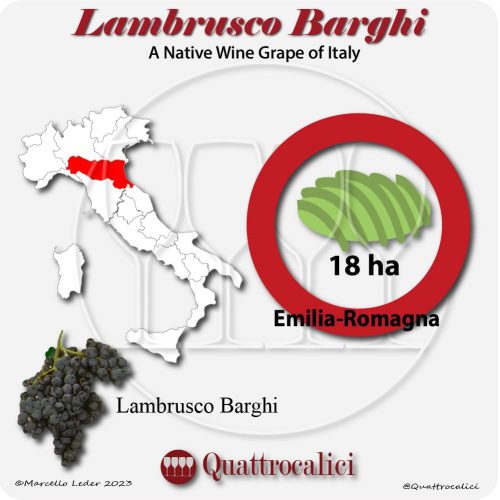



The Lambrusco Barghi grape variety is part of the larger family of Lambrusco varieties, cultivated in the regions overlooking the Po Valley, especially in Emilia-Romagna and Lombardy. Pliny the Elder already mentioned the “Vitis Labrusca” in his work as a wild species that, once domesticated, could lead to the production of wine grapes. The origin of Lambrusco Barghi is lost in time, but it is probably Tuscan. It was a grape variety extensively cultivated until the 1960s in the estates of Count Corbelli in both Castelnovo di Sotto and Rivalta, in the province of Reggio Emilia. Lambrusco Barghi is one of the many Lambrusco varieties cultivated in Emilia-Romagna, which fall under various local designations of origin, including Reggiano DOC and Colli di Scandiano e di Canossa DOC.
Lambrusco Barghi is known for the production of sparkling wines, characterized by a pronounced freshness and fruitiness. Here is an overview of its cultivation, production characteristics, and the wines derived from it.
Cultivation Characteristics
Lambrusco Barghi thrives in a temperate climate, with hot summers and mild winters, typical of the Emilia-Romagna region. It is resistant to climatic variations and adapts well to different environmental conditions. It prefers fertile, well-drained soils, often of alluvial origin, with good water retention capacity. Sandy and clayey soils are ideal for this grape variety. The Lambrusco Barghi plant is vigorous and requires careful canopy management to ensure good sun exposure and aeration of the clusters. Pruning should aim to control the plant’s productivity, promoting a moderate yield to improve fruit quality. Green pruning, with cluster thinning, is essential. The yield per hectare is usually kept low to ensure a higher concentration of sugars and aromas in the clusters.
Production Characteristics
Harvesting is generally done by hand, between September and October, when the clusters have reached optimal ripeness. The vinification of Lambrusco Barghi can involve various techniques, but fermentation in steel tanks is usually preferred to maintain the wine’s freshness and liveliness. Refermentation in the bottle or in an autoclave (Charmat method) is common to achieve the characteristic perlage.
Wine Characteristics
The wines from Lambrusco Barghi are generally ruby red with violet reflections, often with a lively and persistent foam. The aromatic profile is rich and fruity, with notes of red fruits like cherry, strawberry, raspberry, and blueberry. Depending on the winemaking techniques, floral and spicy notes may also emerge. On the palate, Lambrusco Barghi wines are fresh, with good acidity and a light body. The fine perlage contributes to a sensation of liveliness and freshness. The tannins are usually soft and well-integrated. Lambrusco Barghi wines pair perfectly with Emilian cuisine, such as cured meats, cheeses, pasta dishes with ragù, and meat dishes. Their freshness also makes them ideal for accompanying fried dishes and pizzas.