


The Best Tool to Learn about Italian Wine

Italy's Native Wine Grapes Guide

Alicante

Grape's Data Sheet

The Alicante Wine Grape in Italy

Alicante - The Grape and the Wines

The Alicante grape variety is definitely of Spanish origin. In the 1400s, it was brought to Sardinia during the Aragonese domination, a period during which this grape variety, with its numerous genetic variants (including Cannonau and Grenache), also reached France, especially in the Roussillon area. Alicante, Tocai Rosso, and Cannonau seem to share the same genetic heritage, thus they are the same variety, while Vernaccia nera di Serrapetrona, despite some differences, also belongs to the genetic variety of Grenache, and therefore Alicante. The Alicante vine is widespread in Tuscany, Lazio, Umbria, Liguria, and Emilia. It is known as Cannonau in Sardinia, as Vernaccia nera in the Marches, and as Tocai Rosso in Veneto.

The main organoleptic characteristic of Alicante wine is undoubtedly its intense dark red color, indeed the grape skins tend to be dark blue and violet. It is a particularly alcoholic wine, so much so that it is sometimes blended with musts of lower sugar content to produce lighter wines. On the nose, Alicante wine releases a rich and intense bouquet, in which it is possible to distinguish pleasant aromatic notes and tones of dark berries, such as blackberries and blueberries, and intense sweet shades of spices. On the palate, Alicante is distinguished by its full and soft taste, particularly rich in tannins. Excellent pairings with very matured hard cheeses, including goat cheeses, but also perfect with tuna, a fish with a substantial texture.
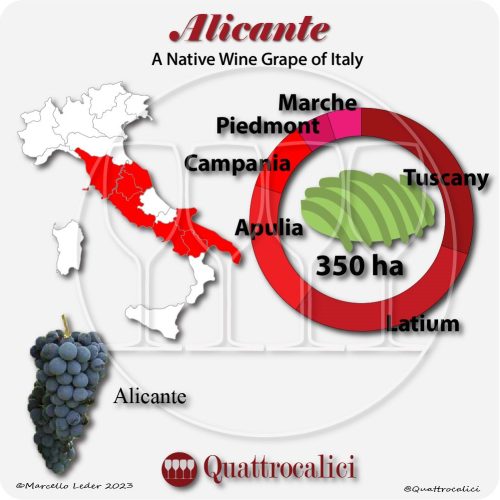
alicante a native wine grape of Italy

Alicante - General Info Table

Alicante is one of the  Local Grapes with Black berry widespread mainly in Liguria, officially listed in the “Catalogo nazionale varietà di vite” since 1970. Its surface under vines in Italy is 370 ha.
Berry colorBlack berry
Grape CategoryLocal Grapes
Main RegionLiguria
Surface under Vines in Italy370 ha
Synonym(s)Cannonau, Tocai rosso, Guarnaccia
Year of listing1970

Alicante - Ampelographic Data

Each grape variety is characterized by Ampelographic Descriptors that define the appearance of its main elements. The ampelographic features of the Alicante grape variety are:
Leaf Features
The leaf of the Alicante grape variety is medium-sized, orbicular, with three lobes.
Bunch Features
The bunch of the Alicante grape variety is medium-sized, cone-shaped.
Berry Features
The berries of the Alicante grape variety are , of medium-sized shape and with very waxy, firm and black-bluish colored skin.

Alicante - Wine Features

The Varietal Wine obtained from each and every Grape Variety, features precisely defined organoleptic characteristics. Referred to Alicante grapes, they are as follows:
Varietal Wine's features
The wine obtained from Alicante grapes is . On the palate the wine is dry, fragrant, full bodied.

Alicante - Agricultural & Productive Features

Each and every grape variety features very specific agricultural and productive characteristics, such as productivity, yield, ripening time, the ideal type of climate or pruning system, sensitivity to adversities, varying degrees of disease resistance and many others. For the Alicante grape variety, the main characteristics are:
Vegetative vigormedium vigor
Productivityhigh, normal

Alicante - Appellations of Origin

The Quattrocalici Grape Varieties Database collects data on all grape varieties that are explicitly mentioned in at least one Italian PDO (Protected Designation of Origin) or PGI (Protected Geographical Indication) denomination. The Alicante grape variety is mentioned in the regulations of the following denominations:
DenominationTypeRegion
Colline del Genovesato IGTIGTLiguria
Colline Savonesi IGTIGTLiguria
Marche IGTIGTMarche
Maremma Toscana DOCDOCTuscany
Ravenna IGTIGTEmilia-Romagna
Riviera Ligure di Ponente DOCDOCLiguria
Riviera Ligure di Ponente DOC sottozona QuilianoSottozona DOCLiguria
Rubicone IGTIGTEmilia-Romagna
Sicilia DOCDOCSicily