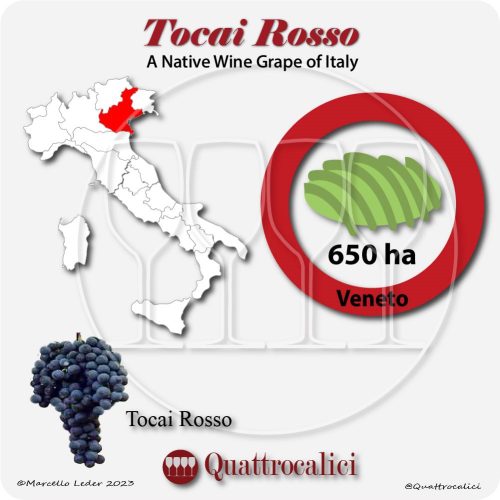


The Tocai Rosso grape, an indigenous variety of the Colli Berici in the province of Vicenza, likely traces its farthest origins to Aragon in Spain, where it is known as Garnacha. From there, it reached Sardinia, where it was named Cannonau, first mentioned at the end of the 16th century, and later traveled to France, giving rise to the Grenache and Gamay varieties. Finally, it made its way to the Italian Peninsula, where it is known as Alicante, Cannonau, or Tocai Rosso, depending on the cultivation region. The Vernaccia Nera grown in Serrapetrona also appears to belong to the same lineage. As Tocai Rosso, it is exclusively cultivated in Vicenza and, particularly, in the Colli Berici and some valleys in the eastern Monti Lessini. In this area, its presence has been recorded since the mid-19th century, when, according to tradition, it was brought by a farmer serving in the Austro-Hungarian army.
Listed in the National Register of Grape Varieties for Wine Production since 1970, Tocai Rosso has been recommended for cultivation in the province of Vicenza since 2005, and it is also authorized in Treviso and Venice. It accounts for over 80% of the wine production in the DOC Colli Berici. Since 2007, due to the dispute with Hungary over the name Tocai, the synonym “Tai” was introduced “exclusively for the designation of DOP and IGP wines produced from grapes harvested in the Veneto region.”
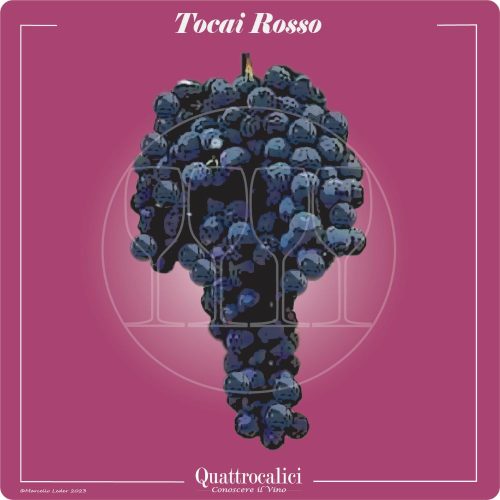
From an ampelographic perspective, the Tocai Rosso grape has medium-sized, rounded, trilobed leaves. Its clusters are medium-sized (about 8 inches long), compact, and pyramid-shaped, often with one or two prominent wings. The berries are medium-sized, slightly oval, with a highly pruinose skin that is thick but not very firm, and colored blue-violet. Tai Rosso, the wine produced from Tocai Rosso, has a not particularly deep ruby red color. On the nose, it is vinous, intense, broad, and distinctive, with slight herbal notes, and aromas of cherry and violet. On the palate, it is balanced, fresh, with a proper tannic structure, a hint of bitterness, and possible notes of raspberry and a almond-like finish. It is a wine best enjoyed young.