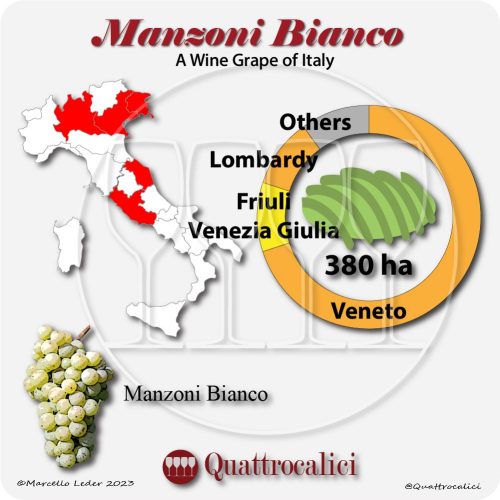




The Manzoni Bianco grape variety, also known as Incrocio Manzoni 6.0.13, is the most famous among the clones created and experimented with by Prof. Luigi Manzoni, who was the principal of the Conegliano School of Enology at the time. These experiments were conducted in the 1930s, focusing on the genetic improvement of the vine through crossbreeding and hybridization. Manzoni Bianco 6.0.13 is considered an indigenous grape variety of the province of Treviso, and it is the result of a cross between Riesling Renano and Pinot Bianco. Today, it is mainly cultivated in the Triveneto area and is included in the blends of some denominations such as Colli di Conegliano Bianco DOCG, Breganze Bianco DOC, and Trentino Bianco DOC, as well as several Indicazione Geografica Tipica wines, for which it is often vinified in purity. The distinguishing feature of Manzoni Bianco is its ability to produce wines with good fixed acidity and an interesting aromatic profile.
Manzoni Bianco 6.0.13 is a grape variety that exhibits remarkable adaptability to very different climates and soils, although it prefers hilly, non-compact, deep, fresh, and fertile soils, with a moderate production. From an ampelographic perspective, Manzoni Bianco 6.0.13 has a small, conical or cylindrical, sometimes winged cluster, moderately compact (weighing between 80 and 150 grams). The berry is medium-small, spherical, and yellow-green in color, with a thick, fairly firm, moderately pruinose skin and an aromatic flavor. The wine obtained from Manzoni Bianco 6.0.13 or Incrocio Manzoni is distinguished by its finesse and elegance, moderate alcohol content, and good acidity. It is used in the production of wines of notable quality, fine and delicate, yet with good body and excellent balance.