


The Tocai Friulano grape variety is an indigenous white-skinned grape from Friuli-Venezia Giulia. It is a variety with very ancient origins, with written records dating back more than two centuries. It is believed to have been imported from Hungary into Veneto and Friuli-Venezia Giulia, though there are no analogies with any grape variety from that nation. More recent studies suggest it corresponds to the Sauvignonasse grape variety, of French origin, which has almost disappeared in its homeland but is present in other countries such as Chile. Despite its name, the Tocai Friulano grape produces a wine entirely different from the Hungarian Tokaji, which is made from a blend of Furmint, Hárslevelű, and Muscat Lunelu grapes, and whose name refers to a specific Hungarian geographic area. However, a ruling by the European Court of Justice in June 2008 resolved the long-standing dispute with Hungary over the wine denomination Tokaji.
The name Tocai Friulano for the wine has been replaced with “Friulano” in Friuli and “Tai” in Veneto. The decree of September 25, 2008, provides for the registration of the synonym “Friulano” for the grape variety “Tocai Friulano” in the national register of grape varieties. Therefore, the correct name of the grape variety remains Tocai Friulano, and this is what we refer to here.
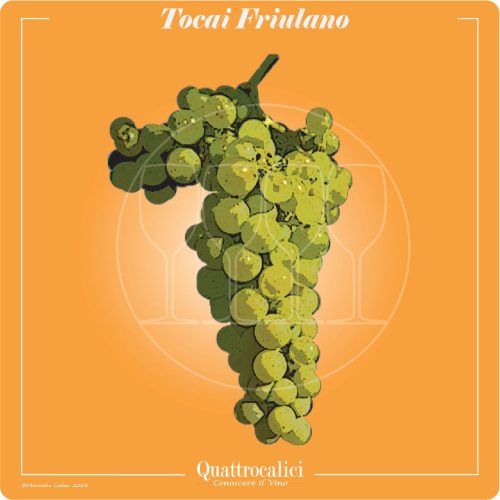
From an ampelographic perspective, the Tocai Friulano has medium-large, orbicular or pentagonal, trilobate leaves. Its bunch is medium-sized, trunk-pyramidal, rather compact, and features two wings, one of which is sometimes very pronounced. The berry is medium, spherical, with a yellow-green skin covered in bloom. The Tocai Friulano grape produces a straw-yellow wine with greenish hues. The aroma is delicate and marked by characteristic notes of almond blossom and bitter almond. On the palate, it is smooth and boasts excellent structure, with a good balance between freshness, savoriness, and alcohol content, and a pleasant almond-like persistence.
