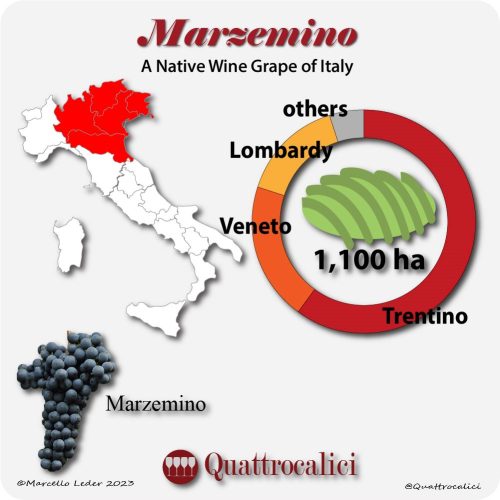



The most well-known Marzemino grape variety is the one originating from Veneto, now also present in Trentino, Lombardy, Friuli, and Emilia. Originally, this name was used to designate numerous grape varieties, often very different from each other, making its origin quite uncertain. Some claim it originated from Carinthia, while others suggest it comes from the Padua area. What is certain is its recurring connection with Veneto. In Germany in the 1600s, a wine called “Marzemino di Bassano del Grappa” was reported. Some believe that the name derives from late Latin “Marzarimen,” meaning March grain, due to the small size of its berries. Currently, the existing biotypes are grouped into two large categories, Marzemino Gentile or Comune and Marzemina Bianca or Padovana.
The differences between the two subspecies can be observed in the presence or absence of tomentum (hairiness) on the underside of the leaf, the characteristics of the rachis (herbaceous or woody), the texture of the berry, and the thickness of the skin. In both cases, Marzemino has long, pyramidal, winged, and compact clusters. The berries are medium-sized, spherical, with a fine, resistant, pruinose skin, and are bluish-black in color. Another characteristic of Marzemino is the reddish-violet coloration the foliage takes on in the summer. The Marzemino grape variety prefers poor soils with calcareous, clayey, or basaltic characteristics, with good exposure and protection from the wind. It suffers from powdery mildew, botrytis, and rot but does not have significant issues with downy mildew. It has very high yields, which, if kept under control, can produce interesting wines. It is generally trained using the pergola system. In Emilia and Veneto, it is sometimes used to produce light, semi-sweet, or occasionally sweet sparkling wines. In the Conegliano area, when properly dried, it forms the base of Refrontolo Passito wine. When vinified in purity, Marzemino produces wines with deep color and elegant fruity aromas, with floral nuances of violet. On the palate, these wines have good alcohol content, with smooth tannins balanced by a pleasant sapidity. In Trentino, it finds its ideal territory to produce more important and structured wines, especially in the Isera and Ziresi subzones of Trentino DOC, near the Vallagarina, south of the provincial capital, where it takes on balsamic and spicy notes and mint nuances, which are rare in other regions. It is part of numerous other denominations of origin, such as Garda DOC, the aforementioned Colli di Conegliano DOCG, Bardolino DOC, Breganze DOC, Botticino DOC, Trentino DOC, Colli di Scandiano e Canossa DOC, Reggiano DOC, and others.