


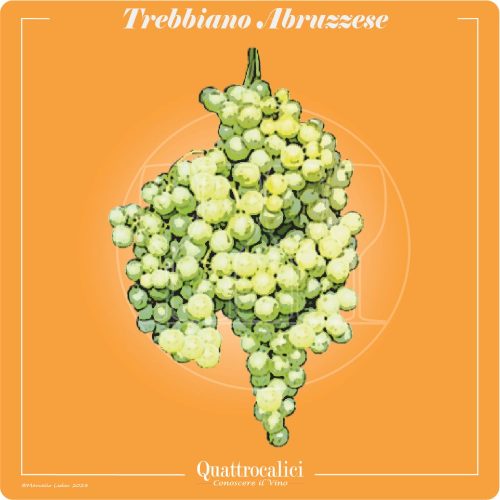
The Trebbiano Abruzzese grape variety belongs to the large family of Trebbiani, and it is very similar to Biancame, which is itself a biotype of Trebbiano Toscano, one of the most widely cultivated white grape varieties in central Italy (Emilia-Romagna, Marche, Lazio, and Abruzzo). The Trebbiani family of grapes has been known in Italy since Roman times. Its name derives from “Trebula,” meaning farmhouse. Pliny the Elder describes a “Vinum Trebulanum,” which, according to this interpretation, would mean “country wine” or “homemade wine.” Distinguishing the various Trebbiano clones, whose names often indicate their origins or primary areas of cultivation, is not always straightforward.
The first documented evidence of Trebbiano in Abruzzo dates back to the 1500s, but it is highly likely that this variety was cultivated there as early as Roman times.
The Trebbiano Abruzzese exhibits significant differences from other Trebbiani in terms of ampelographic characteristics such as shoot tip, leaf shape, cluster form, berries, and ripening period. It is the most widely planted white grape variety in the region, with approximately 5,000 hectares spread across all four provinces, with the coastal strip being the most important area for cultivation.
The Trebbiano Abruzzese is a highly versatile variety, producing wines with a straw-yellow color, greenish reflections in their youth, and good acidity. These wines are light-bodied and not overly structured. Their aromas are predominantly floral and fruity, with similar notes reflected on the palate, often followed by a subtle bitter almond finish. When harvested at full technological ripeness, it can yield wines with high alcohol content, though sometimes less intense and complex in aromatic characteristics.
The Trebbiano Abruzzese demonstrates exceptional potential when cultivated with low yields and vinified with care. Depending on the harvest timing, vinification methods, and winemaking techniques, it can produce both age-worthy wines with remarkable structure and body—qualities unexpected in a white wine—and ready-to-drink wines with fresh fruity notes, good intensity, and moderate complexity.
