

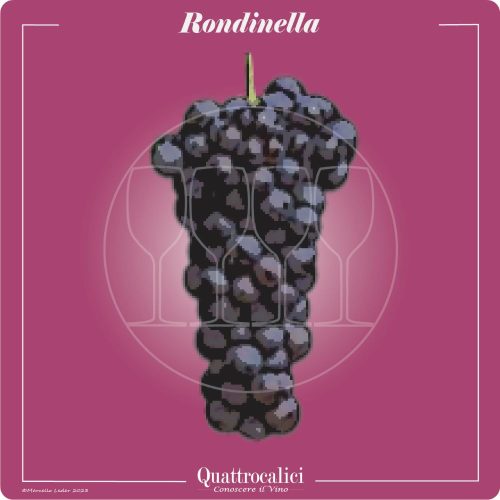
The Rondinella grape variety is an indigenous grape from the province of Verona, whose origins remain unknown. Recognized by ampelographers only in the late 19th century in the Verona area, its name likely derives from the blue-black color of its berries, reminiscent of the plumage of a swallow (Italian: rondine). It is typically vinified in blends with other varieties from the province of Verona, particularly in Valpolicella and the Bardolino area, such as Corvina, Corvinone, and Molinara. These blends are the foundation of Valpolicella and Bardolino wines, with Amarone being the most prominent. Thanks to its ability to accumulate sugars, this grape variety is used not only in Amarone but also in the blend for Recioto della Valpolicella. The drying process concentrates the aromatic and sugar compounds, resulting in wines with high alcohol content and exceptionally rich aromas.
From an ampelographic perspective, Rondinella has medium-large, five-lobed leaves characterized by a green color with golden or bronzed reflections along the edges. Its cluster is compact, winged, and elongated-pyramidal in shape. The berries are spheroidal, dark-colored, with thick, leathery skins covered in pruina.
The wines where Rondinella showcases its potential are characterized by an intense ruby red color, with slight purplish nuances. On the nose, they have a fruity and complex bouquet, featuring notes of ripe red fruits, cherries, tobacco, and spices. The tannins are smooth yet pronounced, and their complex structure makes them perfect for pairing with grilled meats, stews, festive Sunday meals, and special occasions. In the case of Recioto, they also serve as excellent meditation wines.
