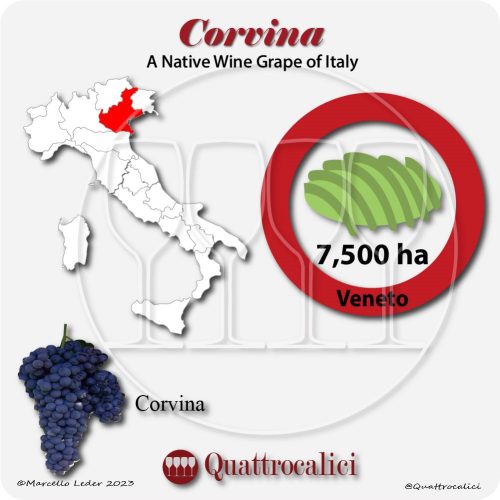


Corvina is a black grape variety characteristic of the province of Verona, particularly of Valpolicella and the eastern shore of Lake Garda. Its name probably derives from the color of the ripe berry, which resembles the feathers of a crow, although in reality its wines do not have a particularly intense coloration. When cultivated in poor, hilly soils, Corvina produces wines with good intensity aromas reminiscent of small fruits and spices, especially pepper. In the past, several types of Corvina were mentioned, described by Acerbi as early as 1825, but today it is clear that there is Corvina, with its various identified and recognized biotypes, and Corvinone, which was considered for years to be a mutation of Corvina Veronese but was recently classified as a distinct variety.
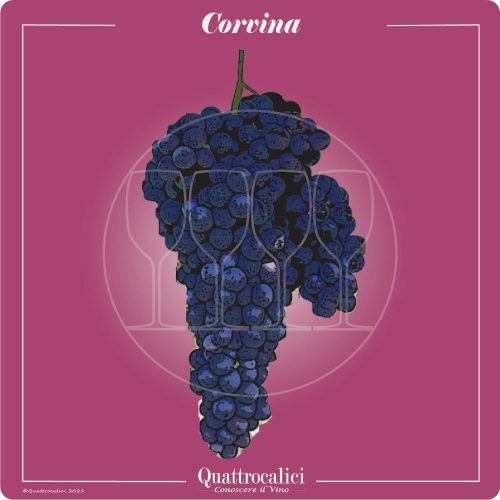
Corvina was registered in the National Register in 1969 and is suitable for cultivation in the provinces of Verona and Brescia and authorized in Sondrio (where it is called Corvino). It is used in the DOC Valpolicella, Garda, and Bardolino and in the DOCG Bardolino Superiore. After drying for about a hundred days, Corvina is used to produce Amarone della Valpolicella DOCG and Recioto della Valpolicella DOCG. From an ampelographic point of view, the Corvina cluster is medium-sized, elongated, cylindrical, and pyramidal, rather compact, and often has a long wing. The berry is medium-sized and almost ellipsoidal, and the skin, a splendid bluish-purple, is thick and consistent, very pruinose, and contains a simple and sweet-tasting pulp. It buds late and ripens in mid to late season, so harvesting generally takes place in the last days of September and the first days of October. The wine obtained from the traditional vinification of fresh Corvina grapes has a beautiful intense ruby red color, with aromas dominated by fruity notes (especially cherry). In more complex wines, with aging, it presents interesting spicy and mineral nuances. On the palate, it has great structure, good acidity, and elegant tannins, creating a harmonious and well-balanced ensemble. If produced with great care and good concentration, it can age for many years. From the dried grapes, Recioto della Valpolicella is obtained, a sweet wine of great impact, refined sweetness, and extreme smoothness, and Amarone, great structured reds capable of aging for decades.