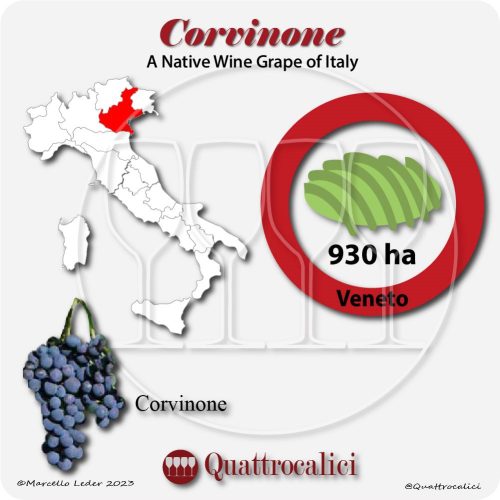


In the past, the Corvinone grape variety was erroneously considered a biotype of Corvina, due to environmental causes or bud mutation. Corvinone was recognized as a distinct variety only recently, in 1993, although the close relationship between the two varieties has been confirmed, and together they constitute the “family” of grape varieties called “Corvine”. The name of these grape varieties could derive from their almost black color, reminiscent of a crow’s plumage, or from “corba”, the basket used to transport the grapes, a name that also appears in various local synonyms (“corbina”). Corvinone gives wines greater finesse compared to Corvina and an extraordinary quality balance. Its name is due to the fact that both the cluster and the berry are larger in size compared to Corvina.
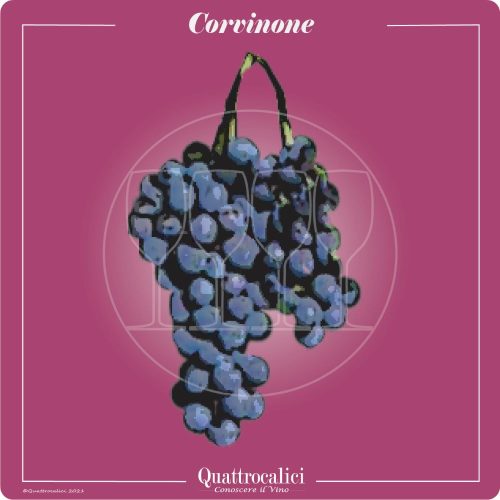
Corvinone is widespread throughout Valpolicella, particularly on the hills, due to its natural difficulty in reaching ripeness in flat areas. Corvinone is used to vinify the types of wines of the DOC Valpolicella and Bardolino and in the DOCG Bardolino Superiore. Ampelographically, Corvinone presents substantial differences compared to Corvina, both in terms of the cluster, which is large, pyramidal, less compact, and generally has two well-defined wings, and the berry, which is large, decidedly ellipsoidal, with dark blue skin covered with bloom. Corvinone buds late and usually ripens in the first weeks of October. It is never used in purity but is used in blends with all the other varieties of Valpolicella. When vinified individually, Corvinone tends to have lower alcohol content and more pronounced acidity compared to Corvina and a more intense and broader spectrum of olfactory sensations.