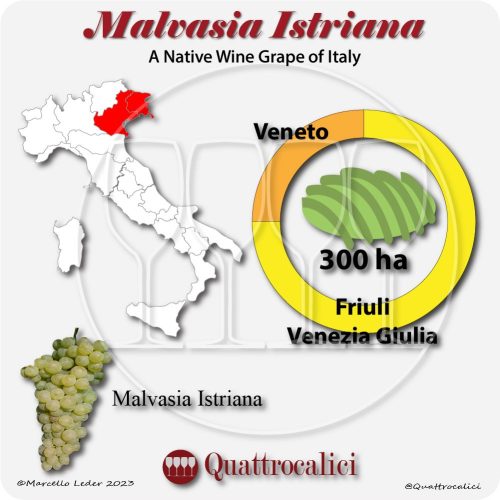



Malvasia Istriana is, among the various white-berried Malvasias, the one most capable of producing non-aromatic wines endowed with great finesse, elegance, and complexity. Of Greek origin, Malvasia Istriana was brought to Italy by the Venetians even before the 14th century. Thanks to the Venetian Republic, from the historical region of the Peloponnese, the grape variety began to spread along the entire upper Adriatic: Istria, Carso, Collio, and Isonzo. Currently, Malvasia Istriana is cultivated throughout Friuli-Venezia Giulia and in the Slovenian Collio. While the grape variety is conventionally used in classic white vinification, producing wines with a fresh, fruity, and delicate character, some winemakers offer more structured, full-bodied, and expressive interpretations, using extended maceration on the skins and aging in oak barrels. This way, particular wines are obtained, with characteristic orange reflections, true gems of Friulian and Slovenian oenology.
The leaf of the Malvasia Istriana grape variety is medium-sized, pentagonal in shape, slightly trilobate or almost entire. The cluster is medium (about 15 cm long), with medium or slightly loose compactness, almost cylindrical, often with a wing. The berry is medium, spheroidal, and regular, with a medium-consistency, pruinose skin, greenish-yellow in color. Malvasia Istriana produces a wine with a straw-yellow color, which, depending on the area of origin and the type of elaboration, can range from greenish reflections to golden straw. Its consistency varies depending on the origin and elaboration. On the nose, it is characterized by remarkable intensity and olfactory complexity, with floral notes of linden, in some cases mineral notes of chalk, and in others vegetal nuances of green olives, all on a background that is sometimes citrusy with mandarin, and other times spicier with hints of fine almond paste. On the palate, wines from Malvasia Istriana are fresh and sapid, full-bodied, and well-structured. The more refined versions or those rich in extracts sometimes elegantly soften sapidity and freshness, resulting in extremely fine and harmonious wines overall.