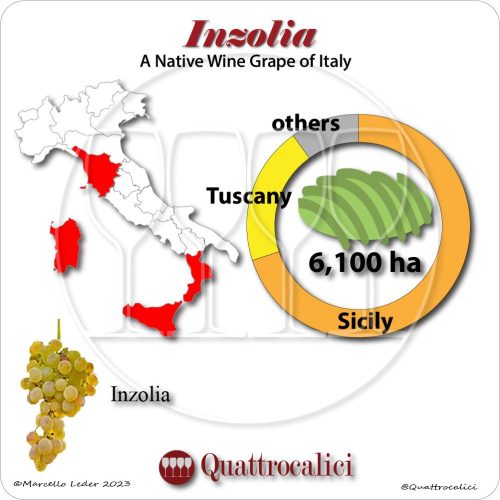


The Inzolia grape variety holds dual significance in the Italian wine context, with a focus in both Tuscany, where it has retained its ancient Norman name Ansonica, and in Sicily, where it has been known since Roman times (Pliny the Elder in his Naturalis Historia mentions a grape called Irsolia) as Inzolia. There is also a black grape variety with the same name, Inzolia Nera. One hypothesis posits that Inzolia is the oldest Sicilian white grape variety, which then spread from the island to Sardinia, Calabria (in the Bivongi area), Lazio, and Tuscany, particularly on the islands of Elba and Giglio, and the Costa dell’Argentario. Others believe it to be a variety originating from France, imported to Sicily by the Normans.
In Sicily, Inzolia is traditionally famous as an ingredient in fortified Marsala wines, but in recent times it is increasingly seen as a dry and fresh white wine, both in blends and as a varietal wine. Wines made from Inzolia are moderately aromatic and tend to exhibit fruity and citrus characteristics with herbaceous notes. Today, Inzolia is found throughout Sicily, particularly in Palermo and Agrigento. It is allowed as a blending grape in many DOC denominations on the island. Inzolia adds a unique note of toasted hazelnuts to wines produced with Catarratto and Grillo. The tendency of Inzolia to significantly lose acidity as it matures is the factor that made it a key component in Marsala wines, but improvements in winemaking techniques and changing consumption trends have also significantly altered the types of wine in which Inzolia is used.