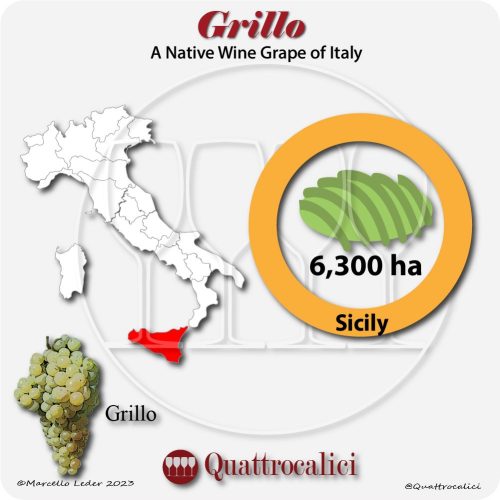


Grillo is a white grape variety mainly grown in western Sicily. The origin of Grillo is probably in Puglia, from where it arrived after the phylloxera outbreak, initially in the Marsala area and then in other provinces of the island. It is also known by the synonym Riddu. Grillo is a characteristic grape variety of the Marsala area and is particularly important in the production of Marsala DOC, where it is one of the most used grape varieties, often alongside Inzolia and Catarratto. Grillo experienced a rapid expansion in Sicily, occupying around 60% of the island’s vineyard area by the 1930s. The best Marsala is indeed obtained by vinifying Grillo. Grillo is capable of producing wines with high alcohol content and is particularly suited for aging.
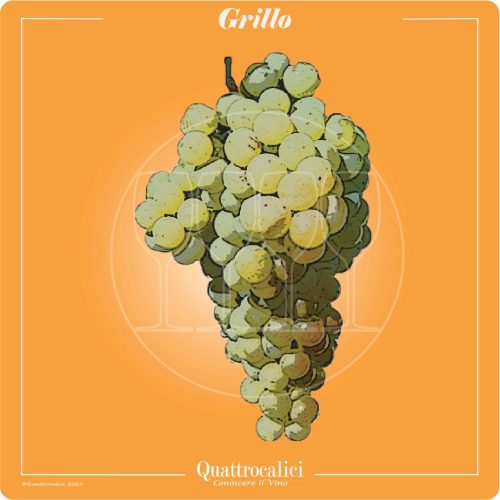
When vinified as a single varietal and with the aid of cryomaceration, Grillo can produce wines with great organoleptic depth, savory, aromatic, and with good longevity potential, superior to all Sicilian whites except those from Etna. Grillo is a vigorous grape variety, and its production is very abundant. From an ampelographic point of view, Grillo has medium-sized leaves, which are three-lobed or five-lobed. Its bunch is conical, winged, and of medium compactness. The berries are small, with thick skins covered in bloom. The color of their skin is a yellowish-green that takes on reddish hues in the final stage of ripening. Grillo is a grape variety that resists heat and drought well and shows adequate resistance to downy mildew. Only powdery mildew can seriously compromise the health of the entire vine. Wines made from Grillo are a clear, bright straw yellow. Fruity and citrus aromas blend with floral notes of wildflowers and orange blossom. On the palate, the wine is fresh, well-structured, with a pleasant, slightly savory, and mineral finish. Grillo pairs best with fish, even raw, and fresh cheese platters.