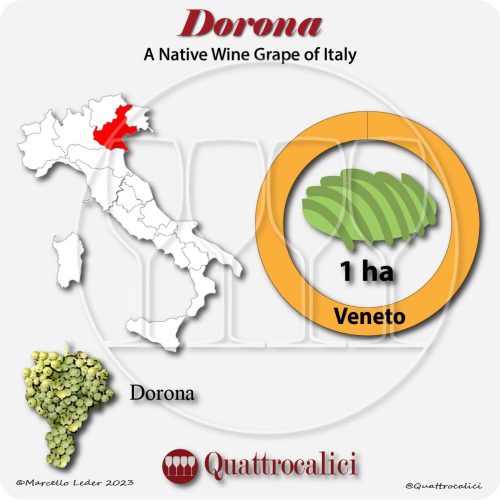



The Dorona di Venezia grape is a native white grape variety from Venice, belonging to the Garganega family. The origin of Dorona is ancient, and by different names, it was likely already cultivated throughout Veneto by the 1800s. Acerbi described it in 1825, and in 1870 it was mentioned as a grape variety cultivated in the province of Treviso. More recently, Dorona has been identified in some vineyards on the Colli Euganei in the province of Padua, on some islands of the Venetian lagoon, and in the province of Vicenza on the Colli Berici, where it was called “Dall’Oro”. The Venetian Lagoon is particularly linked to the history of this grape variety, highly appreciated by the Doges since the 15th century for the taste and color of its golden grapes. In the Lagoon, this grape variety was practically lost during the flood of 1966, when water covered the lower lands for days, destroying almost all Venetian vineyards. The few vines that survived, thanks to the natural resistance of the variety to brackish waters, allowed for the recent rediscovery of the grape.
Until not many years ago, Dorona was believed to be identical to Garganega, at least from an ampelographic point of view, but recent DNA studies have shown it to be a natural cross between Garganega and Bermestia bianca, a table grape from Emilia Romagna. Recently, the variety has been rediscovered and replanted on the island of Mazzorbo, near Venice, in a vineyard of about one hectare.
There are not many examples of wines produced using Dorona as the base grape variety; however, the salient characteristics are fruity and mineral notes, in a wine that is substantially light and not very different from those originating from Garganega.