

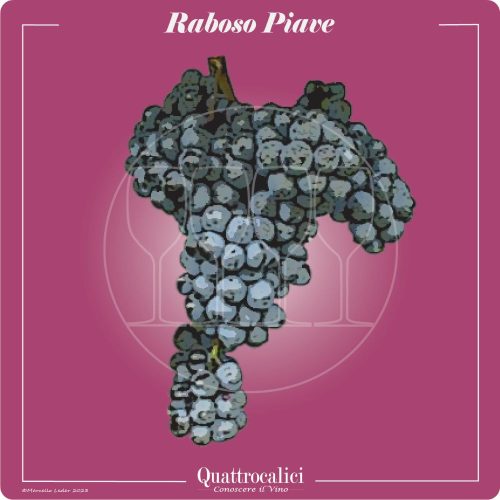
Raboso Piave is an indigenous black-skinned grape variety from the Treviso province, presumably derived from the domestication of wild vines that grew spontaneously on the hills around the Piave River. The origins of the name Raboso are uncertain. It may come from the Raboso stream that flows through the Piave area, or from the dialect expression “rabbioso” (angry), an impression one might get when tasting the wine traditionally produced from this grape, known for its pronounced acidity and tannins, which combine to create a decidedly astringent effect. For this reason, Raboso has always been considered a “rustic” grape, suitable for producing lower-quality products and blending wines. This “traditional” interpretation of Raboso is now complemented by more “refined” styles of the wine, produced using careful vinification techniques (including drying).
Today, Raboso forms the basis of two DOCs (DOC Piave and DOC Venezia) and one DOCG (Malanotte or Malanotte del Piave DOCG). Raboso Piave is also cultivated in the lower Padua area, around the municipality of Bagnoli, where it is known by the synonym “Friularo.” It has nothing in common with Raboso Veronese other than the name and both originating from the same region, Veneto. The cluster of Raboso Piave is large, cylindrical-pyramidal, elongated, compact, and winged, with medium-sized, spherical berries with thick, leathery, pruinose blue-black skins. Raboso Piave grapes have a late ripening period and are usually harvested in the second half of October.
The color of Raboso Piave wines vinified traditionally is an intense ruby red. On the nose, it has vinous aromas that evolve into notes of red fruits and forest berries. On the palate, it is distinguished by its sharp acidity and strong tannic presence, more than by its structure, which is robust but not overwhelming. Raboso produces wines with a good predisposition for aging, often aged for long periods in large oak barrels. Its strong acidity makes Raboso Piave particularly suitable for producing base wines for sparkling wines, following precise white vinification of the grapes. The Piave Malanotte type, however, highlights another characteristic of this grape, namely its suitability for drying, to create wines that are fuller-bodied but also elegant, with more mature, less aggressive tannins, austere and long-lived.
