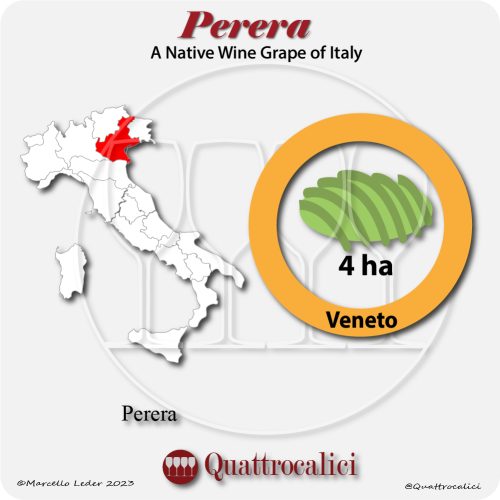


The Perera grape, also known as “Pevarise” in the Valdobbiadene area, was once widely cultivated, especially in the hamlets of Santo Stefano and San Pietro di Barbozza, where it was highly sought after for its tasty berries. However, the earliest records of the Perera grape come from the Vicenza foothills. It was Acerbi (1825) who first documented its presence in Breganze, specifically in the surroundings of Bassano and Marostica, and the Schio district, where two sub-varieties of the grape were noted. The name “Perera” likely derives from the pear-like taste of the grape’s flesh, though it may also refer to the shape of the berries, resembling an upside-down pear. The Perera grape was severely affected by the phylloxera outbreak, leading to its near disappearance.
Recently rediscovered, Perera is now primarily used in blends with Verdiso and Glera within the Colli Asolani Prosecco DOCG, Conegliano Valdobbiadene Prosecco DOCG, and Prosecco DOC designations.
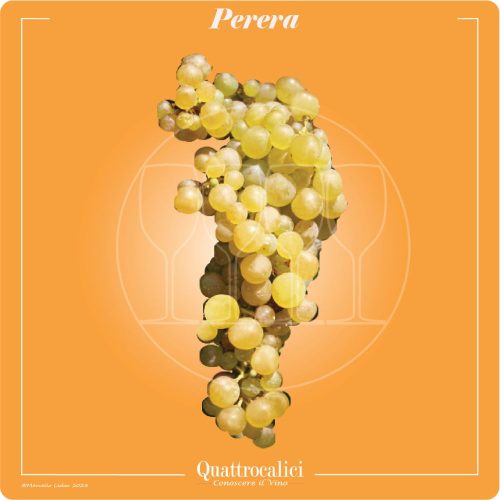
From an ampelographic perspective, Perera has medium-large, pentagonal, trilobate leaves. Its bunch is medium to large, conical or pyramidal, with one or two wings, and is moderately compact. The berries are medium-sized, spheroidal, with a heavily pruined, golden-yellow skin. The wine produced from the Perera grape is straw-yellow with golden highlights, offering a fruity, intense, gentle, and round flavor profile.