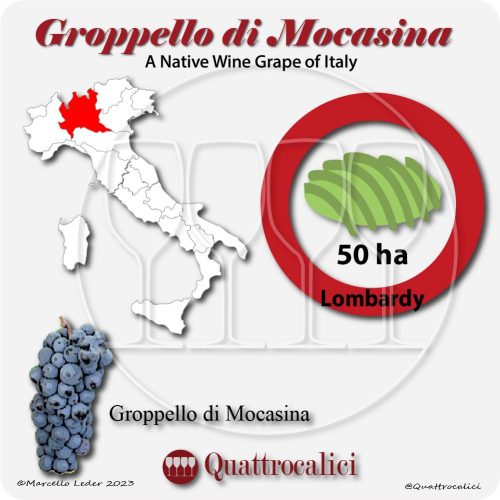


The Groppello di Mocasina grape variety belongs to the Groppelli family, all originating from the western shore of Lake Garda, from Desenzano to the Val di Non in Trentino. The Groppelli varieties are also cultivated in Veneto (in the provinces of Vicenza, Verona, and Treviso) and in Lombardy (in the provinces of Brescia and Bergamo). Many Latin authors, including Virgil and Pliny the Elder, have mentioned the Groppelli. Compared to the other Groppelli, the Groppello di Mocasina, common in Lombardy, produces more intense and full-bodied wines. Often, however, the sub-varieties are found mixed together. The name Groppello derives from “groppo” (“knot” in the Veneto dialect), as the bunches of this variety are very compact, while Mocasina refers to a specific geographical area on Lake Garda that is referenced for the grape’s origin.
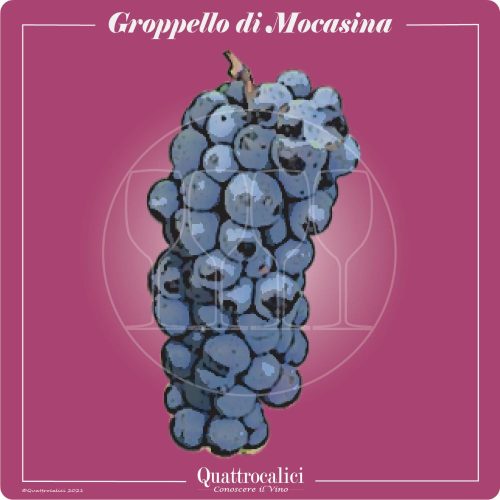
The Groppello di Mocasina prefers hilly soils of morainic origin, clayey, and well-exposed, ensuring good vigor, production, and ripening of the grapes. From an ampelographic point of view, the leaf of the Groppello di Mocasina is medium-sized, pentagonal with three or five lobes, with characteristic whitish shades that make it appear “floury.” The bunch is small, cylindrical or conical, compact, winged, and the berry is medium, round with medium consistency skin covered in bloom. The Groppello di Mocasina is vinified both as a single variety, together with other Groppelli, and blended with other local varieties, depending on the production area. When vinified as a single variety, the Groppello produces wines with a beautiful bright ruby color, very lively, with a good range of aromas, very delicate and fruity with small touches of spices. On the palate, it presents good softness, light but fairly full-bodied, with characteristic freshness due to good natural acidity. It is a light wine, suitable for pairing throughout a meal, from fresh cold cuts to pasta with sauce, to red meats and moderately aged cheeses. The Groppello is a wine to be enjoyed young, although it can bear the mention Riserva after two years of aging, during which it develops more pronounced spiciness that pairs well with more elaborate red meat dishes. In the Garda area, Groppello is blended with Marzemino, Sangiovese, and Barbera to vinify Garda Classico, resulting in a richer and fuller-bodied wine, best accompanied by game meats.