



The Best Tool to Learn about Italian Wine

Italy's Native Wine Grapes Guide

Carmènere

Grape's Data Sheet

The Carmènere Wine Grape in Italy

Carmènere - The Grape and the Wines

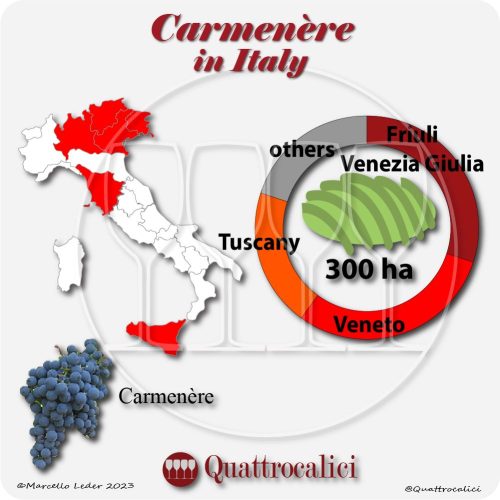
The Carmenère grape originates from the ancient “Vitis Biturica” of Albanian origin, brought to France by the Romans. Its name might derive from “carmine,” due to the deep purple color of the wine it produces. It appears that all Bordeaux varieties descend from this original vine. Carmenère is very delicate and subject to berry shatter (flower abortion), which is why its cultivation was almost entirely abandoned in France. Today, the country where it is most widespread is Chile. Thanks to Carmenère’s success in Chile, the variety has been considered in several other regions of the world, including New Zealand, and is now receiving increasing attention in its native Médoc. In Italy, it is found in Veneto and Friuli-Venezia Giulia, where Carmenère was often mistaken for Cabernet Franc in the past, as well as in Franciacorta (Curte Franca), where some wineries have developed excellent pure varietal wines.

In reality, Carmenère morphologically resembles Merlot, from which it differs in the color of the young leaves (green in Merlot, reddish in Carmenère) and in the ripening period, with Carmenère ripening a couple of weeks earlier. Carmenère is a late-ripening variety and thus needs sunlight to reach its full potential. In the right environment, it can produce fine red wines with intense colors, featuring the appealing fleshy texture of Merlot and the herbaceous notes of Cabernet Sauvignon. Carmenère wine has distinctive and unmistakable characteristics, making it enjoyable when young but also suitable for aging. It is also a very versatile wine with all traditional pairings, ideal for roasts, both white and red meat, game, and aged cheeses. It should be served in wide glasses at a temperature between 16 and 18°C (60-64°F).
carmenere wine grape in Italy

Carmènere - General Info Table

Carmènere is one of the  Local Grapes, International Grapes with Black berry widespread mainly in Veneto, officially listed in the “Catalogo nazionale varietà di vite” since 1996. Its surface under vines in Italy is 1074 ha.
Berry colorBlack berry
Grape CategoryLocal Grapes, International Grapes
Main RegionVeneto
Country or Area of OriginBordeaux
Surface under Vines in Italy1074 ha
Year of listing1996
carmenere nel mondo

Carmènere - Ampelographic Data

Each grape variety is characterized by Ampelographic Descriptors that define the appearance of its main elements. The ampelographic features of the Carmènere grape variety are:
Leaf Features
The leaf of the Carmènere grape variety is medium-sized, wedge-shaped, pentagonal.
Bunch Features
The bunch of the Carmènere grape variety is sparse, medium-sized, cylindrical, cone-shaped.
Berry Features
The berries of the Carmènere grape variety are medium-sized, of spheroidal shape and with Buccia pruinosa, firm and black-bluish colored skin.

Carmènere - Wine Features

The Varietal Wine obtained from each and every Grape Variety, features precisely defined organoleptic characteristics. Referred to Carmènere grapes, they are as follows:
Varietal Wine's features
The wine obtained from Carmènere grapes is ruby red. On the palate the wine is warm, herbaceous, tannic.

Carmènere - Agricultural & Productive Features

Each and every grape variety features very specific agricultural and productive characteristics, such as productivity, yield, ripening time, the ideal type of climate or pruning system, sensitivity to adversities, varying degrees of disease resistance and many others. For the Carmènere grape variety, the main characteristics are:
Vegetative vigorhigh vigor
Productivityfair, normal
Sensitivitiesmillerandage

Carmènere - Appellations of Origin

The Quattrocalici Grape Varieties Database collects data on all grape varieties that are explicitly mentioned in at least one Italian PDO (Protected Designation of Origin) or PGI (Protected Geographical Indication) denomination. The Carmènere grape variety is mentioned in the regulations of the following denominations:
DenominationTypeRegion
Alto Livenza IGTIGTFriuli-Venezia Giulia, Veneto
Arcole DOCDOCVeneto
Bagnoli di Sopra o Bagnoli DOCDOCVeneto
Bagnoli di Sopra o Bagnoli DOC sottozona ClassicoSottozona DOCVeneto
Breganze DOCDOCVeneto
Colli Berici DOCDOCVeneto
Colli Euganei DOCDOCVeneto
Colli Trevigiani IGTIGTVeneto
Collio Goriziano o Collio DOCDOCFriuli-Venezia Giulia
Conselvano IGTIGTVeneto
Corti Benedettine del Padovano DOCDOCVeneto
Curtefranca DOCDOCLombardy
Friuli Colli Orientali DOCDOCFriuli-Venezia Giulia
Friuli Grave DOCDOCFriuli-Venezia Giulia
Friuli Latisana DOCDOCFriuli-Venezia Giulia
Garda DOCDOCLombardy, Veneto
Lison Pramaggiore DOCDOCVeneto, Friuli-Venezia Giulia
Marca Trevigiana IGTIGTVeneto
Mitterberg IGTIGTTrentino-South Tyrol
Montello e Colli Asolani DOCDOCVeneto
Montello e Colli Asolani DOC sottozona VenegazzùSottozona DOCVeneto
Montello Rosso o Rosso del Montello DOCGDOCGVeneto
Piave DOCDOCVeneto
Provincia di Mantova IGTIGTLombardy
Riviera del Brenta DOCDOCVeneto
Sebino IGTIGTLombardy
Trentino DOCDOCTrentino-South Tyrol
Trentino superiore DOCSottozona DOCTrentino-South Tyrol
Veneto Orientale IGTIGTVeneto
Verona o Provincia di Verona o Veronese IGTIGTVeneto
Vicenza DOCDOCVeneto