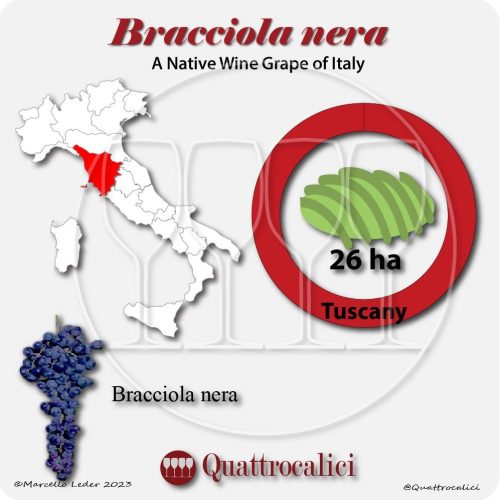



The Bracciola nera grape is an ancient indigenous variety mainly found in the coastal regions of Tuscany and the Riviera di Levante in Liguria, currently cultivated on a small scale. It can be found in some old vineyards and is primarily used to produce blending wine in local IGTs or for table wine production. Bracciola nera has been present in the Cinque Terre region at least since the early 19th century when the Italian naturalist Giuseppe Acerbi described the grape, locally known as Braciola, in 1825. The only Denominazione di Origine Controllata where Bracciola nera plays a significant role is the Colli di Luni DOC, where the grape can be blended with Sangiovese, Canaiolo, Pollera nera, Ciliegiolo, Vermentino nero, and other varieties. Bracciola nera is a late-ripening variety that contributes acidity to the blends in which it is used.
Bracciola nera is a late-ripening variety that often has very high acidity levels in the ripe grapes. The vine can be very productive and generates high yields if not controlled through winter pruning and green harvesting. Bracciola nera is cultivated in the province of La Spezia, which includes the terraced vineyards of the Cinque Terre. In 2000, there were 110 hectares of Bracciola nera planted in Italy, almost all in the province of Massa-Carrara in Tuscany and the province of La Spezia in Liguria, where it is part of the composition of the Colli di Luni Rosso DOC, in which Bracciola nera along with Colombana nera, Vermentino nero, and other local indigenous varieties are authorized to be used up to a maximum of 25% of the wine.