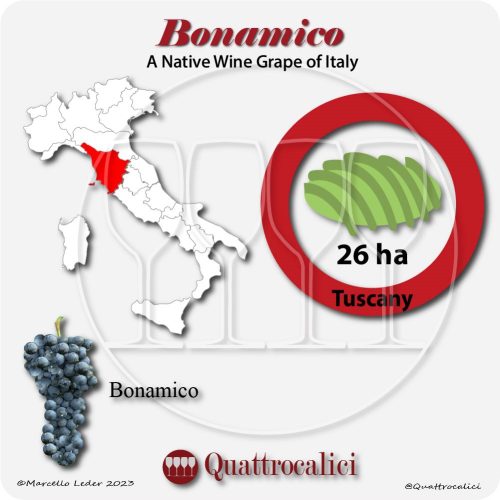



The Bonamico grape is a black grape variety from Tuscany, of ancient origin, already mentioned by Rovasenda in 1877. Until the 1960s, it was quite widespread in its area of origin, appreciated for its late budding, which avoided dangerous spring frosts, and for its consistent and high production even in difficult years. Due to its not particularly outstanding enological qualities, it has been progressively uprooted, so today it is only sporadically present in some old vineyards in the provinces of Pisa and Lucca. Its presence in Maremma is sporadic, but it is almost always found in old vineyards, sometimes under the name Nero Francese.
A genetic study comparing 10 wild vines with 29 Tuscan cultivars established that the variety most similar to the wild vines, particularly the three found in Maremma, is Bonamico, much more so than Sangiovese, Canaiolo, Colorino, Aleatico, and others. This finding is seen as further confirmation of its very ancient origin, probably linked to Maremma. Bonamico was part of an ampelographic reorganization project carried out in Tuscany in the 1960s. On that occasion, it was included, within the province of Pisa, among the five so-called “complementary” grape varieties to be paired with the four “fundamental” ones, which were Sangiovese, Canaiolo, Ciliegiolo, and Syrah. Therefore, its use in prized areas or for the production of great wines destined for aging was excluded, but it was recommended for producing table wines and was still considered interesting for its consistent and excellent yield.