



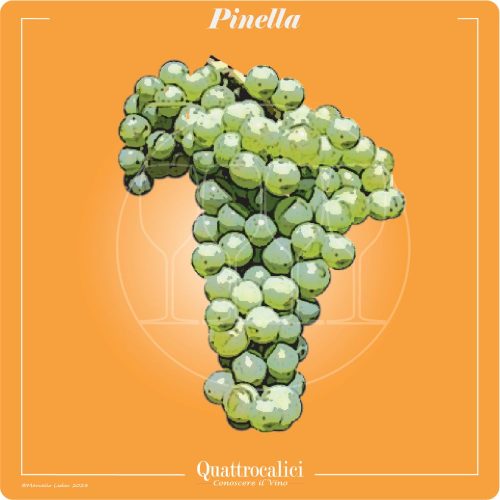
Pinella, a white-skinned grape variety, is today mainly cultivated in the Padua area (DOC Colli Euganei). However, the grape seems to have been first identified in Friuli-Venezia Giulia, where it has now almost disappeared. The origin of Pinella is very ancient and can be traced back to the eastern coast of the Adriatic. In fact, the Pinella produced on the island of Rab, in the Quarnaro Gulf, was highly renowned in Veneto during the 13th century. In the Colli Euganei, there are records of a Pinella or Pinola as early as the early Middle Ages. After the reconstruction of vineyards following the phylloxera outbreak, Pinella was rediscovered and its cultivation expanded over the following decades. Pinella is listed among the varieties suitable for cultivation in the province of Padua (DOC Bagnoli and DOC Colli Euganei), where it is primarily used for the production of DOC Colli Euganei Pinello wine. It was once mainly used as a blending grape for other white wines, but nowadays, it is also vinified in purity.
Origin and History
The Pinella grape has ancient origins, with a history deeply intertwined with the viticulture of the Veneto and Friuli regions. Historical documents attest to its presence in the area since the Middle Ages, although its exact origin remains uncertain. It is hypothesized that the name “Pinella” may derive from “pigna” (pine cone) or “pinolo” (pine nut), due to the compact, elongated shape of its clusters. Although Pinella has never gained widespread national or international recognition, it has always been locally appreciated for its reliability and the freshness of the wines it produces.
During the 20th century, like many native grape varieties, the cultivation of Pinella declined in favor of more international varieties. However, in recent decades, the grape has been experiencing a revival due to growing interest in traditional wines tied to specific terroirs.
Cultivation Areas
Pinella is mainly cultivated in Veneto, especially in the Colli Euganei, and in Friuli Venezia Giulia, although its cultivation is limited to small areas. The vineyards are located in hilly areas, characterized by volcanic and alluvial soils, which give the grapes a particular mineral quality. The climate of these regions, with hot summers and relatively mild winters, along with significant temperature variations between day and night, promotes good grape ripening, enhancing the aromatic profiles and freshness.
Ampelographic and Agronomic Characteristics
Ampelographically, Pinella is distinguished by its medium-sized, compact, conical-shaped clusters, often with wings. The berries are small, spherical, with a thin, yellow-greenish skin, making the grape sensitive to certain fungal diseases, such as botrytis, in high humidity conditions.
From an agronomic perspective, Pinella is a vigorous grape variety but has low yields. It requires careful management in the vineyard to ensure good grape quality. Its sensitivity to fungal diseases necessitates particular attention to pruning and canopy management, especially in wetter years. Harvesting generally takes place between the end of September and the beginning of October, when the grapes have achieved an ideal balance between sugars and acidity.
Organoleptic Characteristics of the Wines
The wines obtained from the Pinella grape are typically light, fresh, and delicate, perfect for daily consumption or as an aperitif. Visually, they present a pale straw-yellow color, often with greenish highlights that indicate freshness.
On the nose, Pinella wines offer a floral and fruity bouquet, with notes of white flowers, green apple, pear, and citrus, accompanied by delicate herbaceous and, in some cases, mineral nuances. These aromas give the wine a fresh and pleasantly fragrant aromatic profile.
On the palate, Pinella wines are characterized by their lightness and liveliness, with good acidity that makes them fresh and thirst-quenching. The structure is light and agile, with a dry and slightly bitter finish, which enhances the cleanliness and drinkability. These wines are best consumed young to fully appreciate their freshness and vibrancy.
