

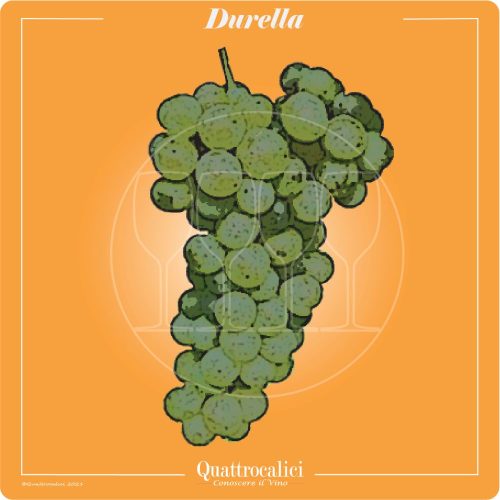
The Durella grape variety has a very ancient history: it seems that at Bolca, a site in the upper Alpone Valley (in the province of Verona) famous for the presence of fossils, some fossilized grapevines have been found that are considered ancestors of current vines. The name Durella seems to derive from the high hardness and resistance of the berry to alterations. In the early decades of the 1900s, “Durello” wine was vinified with maceration of the solid parts, resulting in an acidic, intensely colored, and astringent wine, which was very well suited to increase the acidic content of other wines. Around the 1960s, winemaking “in white” was adopted, producing a very pleasant product. Durella prefers rather high hilly areas characterized by light soils.
For this reason, it found its ideal habitat on the volcanic soils rich in basalt of the Monti Lessini. The grapes benefit from the mineral properties of these soils, which help enrich their natural acidity. Durella has medium-sized, slightly three-lobed or entire leaves. The cluster is medium, short, and stocky, winged, and fairly compact. The berry has a nearly leathery skin, very tannic-bloomed, ranging from yellow-green to golden. The ripening period of Durella is mid to late. The Durella grape variety has a rather wild nature, is vigorous, resistant, and traditionally grown in the Veronese pergola system. Thanks to its exuberant and dynamic freshness, Durella is very well suited for the production of Metodo Classico sparkling wines, capable of withstanding long periods of aging on the lees, but also for simpler sparkling wines made in autoclave. Durello is therefore a wine with good aging potential, which can age in the bottle for over 10 years, developing evolutionary aromas that make it more complex and harmonious.
