


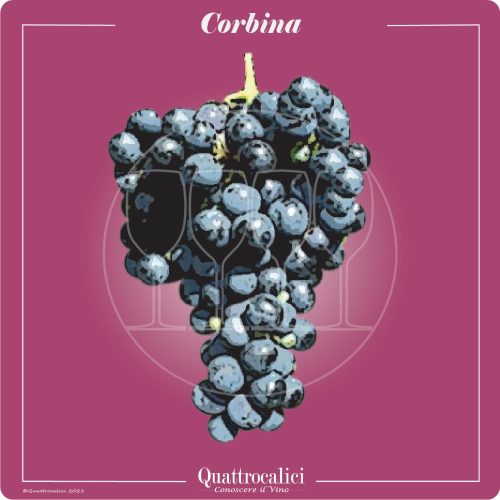
The Corbina grape variety should not be confused with Corvina, or rather the “Corbine” should not be confused with the “Corvine”, even though in many texts and online, the two groups of grape varieties are often associated. In the National Register of Wine Grape Varieties, Corvina, Corvinone, and Corbina are cited as distinct varieties. In the 1800s, Corbina (or “Corbino”) was widespread throughout Veneto, and at the end of the century, Lampertico mentioned at least nine varieties, divided into three groups. Only in the early 1900s, thanks to Marzotto, was clarity brought between Corbine and Corvine, but as already noted, confusion still reigns today. Corbina is a medium-late ripening grape variety, vigorous but not too productive (if cultivated on hills). The rather sparse clusters have a good anthocyanin content, and the wine obtained from it is quite alcoholic, with good acidity and extract, which explains its good structure.
Quoting Marzotto (1925): “Under the name of Corbina, Corbera, Corbinona, and Corbinella, there are several grape varieties in the provinces of Vicenza, Padua, and Treviso that were confused with each other due to the lack of exact identification of their respective ampelographic characteristics and the lack of an exact classification of the various types. Nor was the confusion limited to the varieties of Corbine themselves, with spherical or suboval berries, but it also involved the well-distinguished types of Veronese Corvina, with oval-elliptical berries, so much so that confusing one with the other, making these synonymous with those, constituted a gross error.”
In the Verona area at the time, both families of grape varieties were cultivated, although Corvine were (and still are) widespread in the territories of Bardolino and Valpolicella, while Corbine could be found in the lower Verona area, particularly in the Legnago area. They are still widespread today in the provinces of Vicenza, Padua, and Treviso. Following the advent of phylloxera and the consequent destruction of vineyards in Veneto, the rough character and excessive coloration of Corbine led to their exclusion from the varieties recommended for replanting, which significantly contributed to the reduction in the cultivation of these varieties.
