



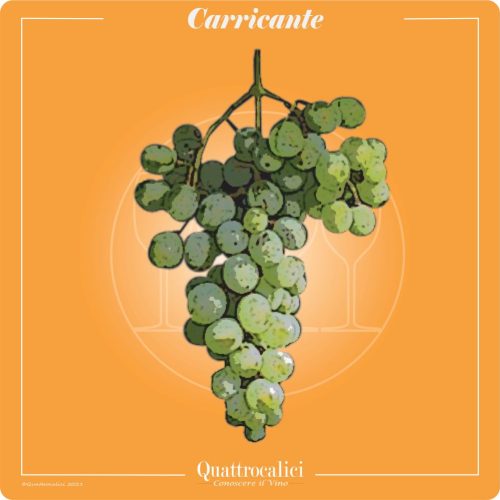
The Carricante grape is the most widely planted white grape variety in the province of Catania, indigenous to Etna, where it grows at altitudes of 750-950 meters above sea level, where Nerello Mascalese struggles to ripen. It is part of the composition of Etna Bianco DOC (60%) and Etna Bianco Superiore DOC (80%). Here, the nature of the soil is strictly volcanic, formed from the breakdown of various types of lava and more recent eruptive materials such as lapilli, ashes, and sands. Additionally, the proximity to the sea helps the accumulation of mineral substances, such as sodium chloride, which is reflected in the wine. The wines obtained from the Carricante grape are characterized by high fixed acidity and a significant malic acid content, making malolactic fermentation almost indispensable.
The Carricante grape produces great white wines with unexpected longevity (over 10 years), dominated by fruity sensations of apple, orange blossom, anise, along with a typical freshness that gives it structure and longevity. Due to the finesse it can confer to wines, it is often vinified together with other indigenous grape varieties such as Catarratto, Inzolia, Minella, or international varieties like Chardonnay. Sometimes it can be found vinified with dark-skinned grapes like Nerello Mascalese. Originally, this practice was common in the higher districts of the Etna area, where Nerello Mascalese struggled to ripen. Initially, Carricante was widespread throughout Sicily, but its use gradually declined as the island’s production began to focus on more structured and alcoholic red wines.
Ampelographically, Carricante has late ripening, with medium-sized, sub-orbicular or pentagonal, trilobed or pentalobed leaves. Its clusters are medium, conical, simple or with a wing, semi-loose or loose. The berries are medium, sub-ellipsoidal, with a skin covered in abundant bloom and firm, yellow-green with greenish-white hues, and flesh with a simple and sweet flavor. It prefers low-expansion training systems, with short and sparse pruning. Carricante has late ripening and abundant and consistent production. Carricante is particularly sensitive to spring frosts and drought, which can cause sunburn on the clusters if not properly protected. Additionally, the grape variety is not very tolerant of fungal diseases (cryptogamic diseases caused by microscopic fungi such as powdery mildew, downy mildew, etc.).
