

The Best Tool to Learn about Italian Wine

Italy's Native Wine Grapes Guide

Barsaglina

Grape's Data Sheet

The Barsaglina Wine Grape in Italy

Barsaglina - The Grape and the Wines

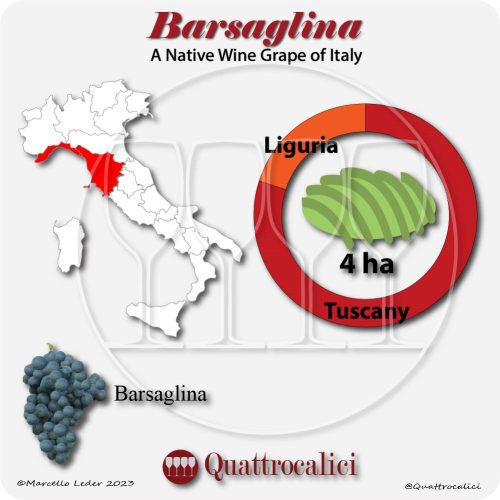
The Barsaglina grape variety is found only in the province of Massa Carrara, where it covers a total cultivated area of just 33 hectares. Barsaglina remains a niche product due to its very low production, but at the same time, it has attracted curiosity and interest from areas outside the Colli Apuani, expanding its territories to reach the Colli di Luni in Liguria. By the late 20th century, the Barsaglina grape was considered on the verge of extinction, largely because it was believed to impart unpleasant aromas to the wine, even emitting bad odors that discouraged drinking.

In reality, the unpleasant odors were due to deficiencies in traditional winemaking techniques where it was cultivated, so much so that accurate vinifications disproved these rumors. In the early 2000s, the cultivated area of Barsaglina was only 30 hectares. It has been demonstrated that the Barsaglina grape has morphological similarities with the better-known Sangiovese, suggesting a close relationship between the two varieties. Barsaglina has a medium-length, pyramidal-shaped cluster. The berry has a very pruinose, black-violet skin and juicy pulp that is slightly pink and has a neutral flavor. It is a grape variety that has good production, is resistant to all adversities but suffers greatly from powdery mildew. The wine obtained from Barsaglina has a high content of anthocyanins and phenols, making it tannic and intensely colored. The nose recognizes aromas of berries, currants, and violets. In the mouth, the wine has good body and presents acidity that allows for good aging. Thanks to these characteristics, Barsaglina, nine years after its introduction into the Candia dei Colli Apuani DOC, has gone from being used in low percentages to add body and color to wines to being vinified as a pure variety.
barsaglina a native wine grape of italy

Barsaglina - General Info Table

Barsaglina is one of the  Native Grapes with Black berry widespread mainly in Tuscany, officially listed in the “Catalogo nazionale varietà di vite” since 1970. Its surface under vines in Italy is 17 ha.
Berry colorBlack berry
Grape CategoryNative Grapes
Main RegionTuscany
Surface under Vines in Italy17 ha
Synonym(s)Massaretta
Year of listing1970

Barsaglina - Ampelographic Data

Each grape variety is characterized by Ampelographic Descriptors that define the appearance of its main elements. The ampelographic features of the Barsaglina grape variety are:
Leaf Features
The leaf of the Barsaglina grape variety is medium-sized, big, pentagonal, with three lobes.
Bunch Features
The bunch of the Barsaglina grape variety is dense, sparse, medium-sized, pyramidal.
Berry Features
The berries of the Barsaglina grape variety are medium-sized, small, of egg-d , spheroidal and black-bluish colored skin.

Barsaglina - Wine Features

The Varietal Wine obtained from each and every Grape Variety, features precisely defined organoleptic characteristics. Referred to Barsaglina grapes, they are as follows:
Varietal Wine's features
The wine obtained from Barsaglina grapes is .

Barsaglina - Agricultural & Productive Features

Each and every grape variety features very specific agricultural and productive characteristics, such as productivity, yield, ripening time, the ideal type of climate or pruning system, sensitivity to adversities, varying degrees of disease resistance and many others. For the Barsaglina grape variety, the main characteristics are:
Vegetative vigorhigh vigor
Productivityhigh, normal

Barsaglina - Appellations of Origin

The Quattrocalici Grape Varieties Database collects data on all grape varieties that are explicitly mentioned in at least one Italian PDO (Protected Designation of Origin) or PGI (Protected Geographical Indication) denomination. The Barsaglina grape variety is mentioned in the regulations of the following denominations:
DenominationTypeRegion
Candia dei Colli Apuani DOCDOCTuscany