

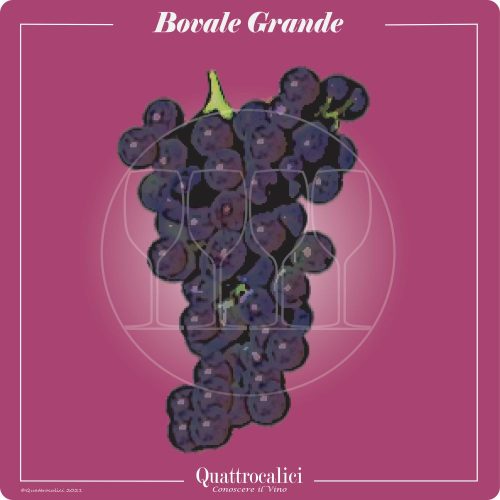
The Bovale Grande grape arrived in Sardinia from the Iberian Peninsula during the Aragonese domination and is present in two distinct varieties: Bovale Sardo or Bovaleddu and Bovale di Spagna or Bovali Mannu (Bovale Grande). There are no certain elements regarding the origin of this group of grape varieties, and it is not clear whether there were two or more varieties of Spanish origin or if they started from a single variety that over time led to the differentiation of the two distinct biotypes. Bovale Grande is vinified together with other black varieties to obtain fine roast wines: in particular, it is included, along with Cannonau and Monica, in the blend for the preparation of Mandrolisai DOC wine. Additionally, in combination with Bovale, it is used for Campidano di Terralba or Terralba DOC wine.
The spread of Bovale Grande in Sardinia is limited to about 27 hectares, mostly in the Terralba area. Here, the soils are sandy, and many vines are on their own roots. From an agronomic point of view, Bovale Grande is not very vigorous and prefers medium expansion training with medium and short pruning. The productive yield of Bovale Grande is abundant but not consistent. The ripening of the clusters in vineyards trained as bush vines occurs by the second decade of September. Wine from Bovale Grande obtained from bush vines and old vineyards has good polyphenolic concentration and richness in extracts, but when trained on trellises with “modern” cultivation methods, like many traditional Italian grape varieties, it becomes diluted, losing identity and character.
