



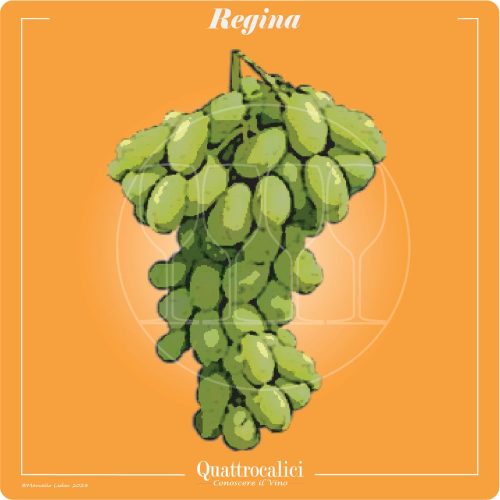
The Regina grape variety is widely used as a table grape and is known by numerous synonyms in Italy. In the Chieti province, it is known as Ortonese or Regina d’Abruzzo. It originates from a cross created by Hungarian G. Mathiasz in 1916, which enabled it to achieve an exceptionally early production. The clusters are cylindrical, winged, and large. The skin is thick, and the pulp is crunchy and juicy, with a sweet, aromatic muscat flavor. Regina is primarily cultivated in cool soils rich in organic matter. The southern regions produce a higher quantity, and the grapes they bring to market have a high sugar content. To facilitate harvest operations, this variety is trained either on a pergola with long pruning or on a tendone system, depending on the specific needs of the growers.
Regina is more rarely used for vinification, producing a wine that is useful, for example, in the preparation of vermouth, as it is light-bodied yet sometimes fairly alcoholic (10-11°) and, importantly, free from distinctive flavors. It is not included in any DOC designation, but it is covered by IGT regulations in the Chieti province.
