


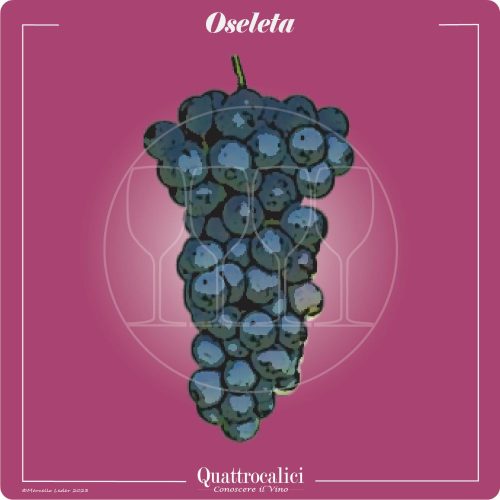
The Oseleta grape variety has been cultivated in the Valpolicella and Monti Lessini areas since ancient times, and in more recent years, it has been part of the blend for Recioto and Amarone della Valpolicella, although it is not explicitly mentioned in the production regulations. The name “Oseleta” likely derives from the fact that the grape was particularly favored by birds, as “osei” means birds in the Venetian dialect. The variety is almost certainly a domesticated form of local wild grapes. It was abandoned in the past due to its low yield, but was rediscovered in the early 1970s and has since garnered significant interest among Valpolicella winemakers. The renewed interest in Oseleta is due to its small, tight, compact bunches and tiny berries, ideal for producing wines with extraordinary concentration. Its polyphenol content is remarkable, making it perhaps the most color-enhancing grape in the Verona province.
Oseleta has very low yields, and its clusters are compact, short, and cylindrical. The berries are medium-sized, obovoid in shape, with a thick, sturdy, bluish-black skin. It is increasingly found throughout Valpolicella and the surrounding areas, but there are no reports of its presence in other Venetian provinces or outside the region. The wine produced from Oseleta is deep ruby red in color. On the nose, it reveals notes of cherry, blueberry, and wild berries, followed by mineral tones and hints of aromatic herbs. On the palate, it is fruity, spicy, tannic, full-bodied, enveloping, persistent, and well-balanced.
