



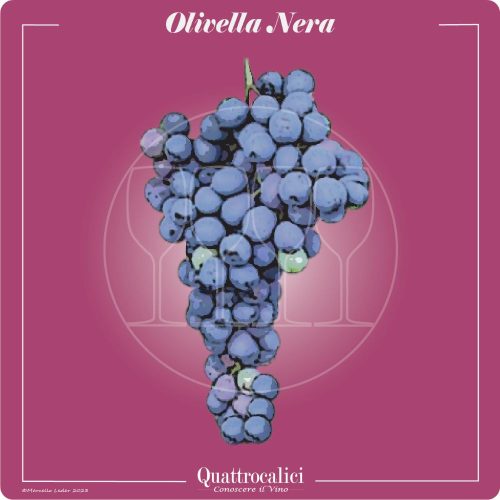
The Olivella Nera is a black grape variety found in Campania and Lazio. Its origins are uncertain, and there has long been confusion about whether it corresponds to the Sciascinoso variety. This confusion stems from the fact that the name Olivella has historically been applied to various grape varieties with elongated, olive-shaped berries. In the regulations for Campanian DOC wines, only Sciascinoso is listed (sometimes referred to as “locally called Olivella”), while Olivella itself is mentioned in the Frusinate IGT regulations in Lazio. Although it is now recognized that these are distinct varieties, the confusion persists. For instance, in the Vesuvio DOC, Olivella is included in the blend for Lacryma Christi Rosso, but once again it is referred to as Sciascinoso “locally called Olivella,” not as a separate variety.
Origins and History
The origins of Olivella Nera date back several centuries. Its name comes from the distinctive shape of the berries, which resemble small olives. This grape’s cultivation is closely linked to the volcanic regions of Campania, particularly around the Vesuvius, where the mineral-rich soil has helped shape the grape’s unique characteristics. In Lazio, Olivella Nera is known as Cesanese Comune and is cultivated mainly in the Castelli Romani area.
Historically, Olivella Nera has been relegated to niche production, often used in blends with other local grapes. However, in recent years, there has been renewed interest in this variety, thanks to the growing appreciation for indigenous grapes and wines that reflect their terroir.
Cultivation Zones
Olivella Nera is primarily grown in Campania and Lazio, where it thrives in volcanic and hilly terrain. In Campania, it is especially prevalent in the Vesuvius region, where the vineyards are planted in soils rich in volcanic ash and lapilli, which give the grapes a distinctive minerality. In Lazio, the grape is found in the Frascati and Castelli Romani areas, particularly around Rome.
The climate in these regions, marked by hot, dry summers and mild winters, with a good diurnal temperature range, allows the grapes to ripen fully, enhancing their aromas and structure.
Ampelographic and Agronomic Characteristics
The Olivella Nera grape features medium-sized, trilobate or pentalobate leaves of a deep green color. The bunches are small and compact, conical in shape, with small, oval, blue-black berries resembling olives, hence the grape’s name. The skin is thin but resilient, rich in anthocyanins, which contribute to the deep color of the wines.
Agronomically, Olivella Nera is a vigorous variety, though it yields relatively low amounts, depending on the climatic conditions of each vintage. The grape is susceptible to fungal diseases like downy mildew and powdery mildew, requiring careful vineyard management. Harvest typically occurs between late September and early October, when the grapes have achieved full phenolic and sugar ripeness.
Organoleptic Characteristics of the Wines
Olivella Nera wines are rich and full of character, with a complex and intense aromatic profile. Visually, these wines show a deep ruby red color with violet reflections, a sign of high anthocyanin concentration.
On the nose, Olivella Nera wines present aromas of ripe dark fruits such as blackberry, plum, and black cherry, accompanied by floral notes of violet and subtle herbaceous hints. With aging, the wines develop spicy notes of black pepper, tobacco, and licorice, adding to their complexity.
On the palate, Olivella Nera wines are full-bodied and structured, with well-integrated tannins and good acidity that balances the powerful fruit flavors. The finish is long and persistent, with alternating fruity and spicy notes in a harmonious balance. Olivella Nera wines also age well, developing further nuances of leather, cocoa, and dried fruit over time.
