


The Neretto di Bairo, also simply known as Neretto, has been present in the Canavese region for centuries, although its true origins remain unknown. This grape variety presents notable challenges in cultivation, particularly due to inconsistent production and low yields. Despite these difficulties, the Neretto di Bairo is capable of producing high-quality grapes that, when vinified, result in wines with lower acidity and more balance compared to Barbera, with which it shares production areas. In addition to the Canavese (notably the communes of Bairo, Valperga, and San Giorgio), the Neretto di Bairo is also found in the Pinerolese region, though to a lesser extent. While it is sporadically present in vineyards, it contributes to the production of Canavese Rosso DOC, but it is rarely vinified on its own.
Given its high vigor and the low fertility of buds at the base of the cane, the Neretto di Bairo requires an expansive training system, such as the traditional Canavese pergola, which allows for long, rich pruning. Its production is inconsistent because it is highly sensitive to rainfall, especially during fruit set. Despite being considered suitable for vinification and for producing young, easy-drinking wines, many winegrowers are abandoning this variety in favor of others with higher and more consistent yields.
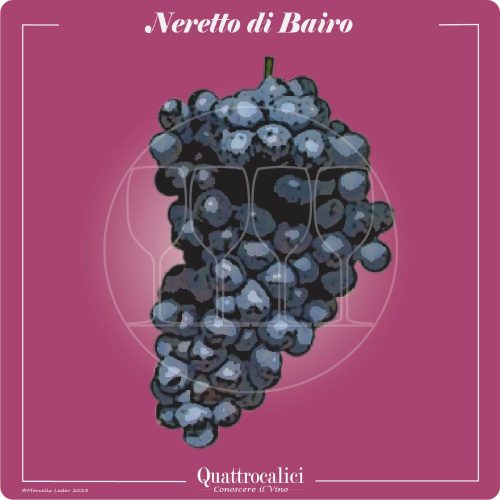
Ampelographically, the Neretto di Bairo has medium-sized, pentagonal, five-lobed leaves with pronounced lobes. Its clusters are medium-sized, conical-pyramidal in shape, with short wings, and moderately compact. The berries are medium-sized, subround to suboval in shape, with a bluish hue and a thick layer of pruina. The wine produced from Neretto di Bairo has an intense ruby-red color. On the palate, it is warm and full-bodied.
