


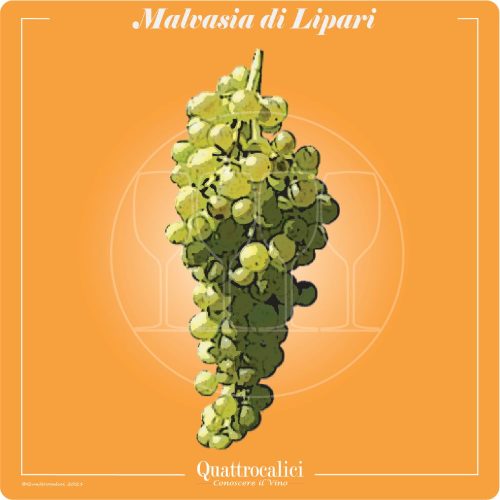
The Malvasia di Lipari grape variety, also known as Malvasia delle Lipari (the name given to the wine produced from it), was originally brought to the Lipari Islands or Aeolian Islands (the volcanic archipelago off the northeastern coast of Sicily) by the Greeks. The name “Malvasia” derives from a contracted variation of Monembasia, a Byzantine stronghold perched on the rocks of a promontory in the south of the Peloponnese, where sweet wines were produced and then exported throughout Europe by the Venetians under the name of Monemvasia. The wine made from this variety became extremely popular, so much so that Venice was full of taverns called Malvase, dedicated to its consumption. The Malvasia di Lipari grape variety and the Malvasia delle Lipari wine were on the brink of extinction, and its current fame is solely due to the passion of a few producers who revived the vineyards and brought renown to this wine.
The Malvasia di Lipari vineyards are primarily distributed across the three islands of Salina, Lipari, and Vulcano and are mostly planted on terrains that extend from sea level up to 400 meters in elevation. In these areas characterized by steep slopes, the vineyards are cultivated on terraces supported by dry stone walls made of lava rocks. These walls not only serve the practical function of retaining the soil and controlling surface water but also make the landscape unique in the world. The soils on which the Malvasia di Lipari vineyards are planted are of volcanic and sandy origin and thus contain the right amounts of magnesium, potassium, and phosphorus, which give the wine the necessary balance of sweetness and acidity. The aging process for the wine is seven months for the passito and six months for the liquoroso and the regular version. From the Malvasia di Lipari grape variety, a pleasant dry white wine is produced, but it is the Malvasia delle Lipari Passito DOC that has gained the most fame. The color of Malvasia delle Lipari Passito DOC ranges from yellow to amber, passing through golden hues. Its aroma is rich with sweet notes of apricot and honey, but at the same time, fresh hints of eucalyptus. On the palate, it is sweet and aromatic, becoming more intense and alcoholic in the passito liquoroso version. Malvasia delle Lipari Passito DOC is best enjoyed at a temperature of 12°C, accompanied by fruit preserves like quince jelly or dry biscuits, especially almond-based ones. Malvasia di Lipari is one of the aromatic Malvasia varieties.
