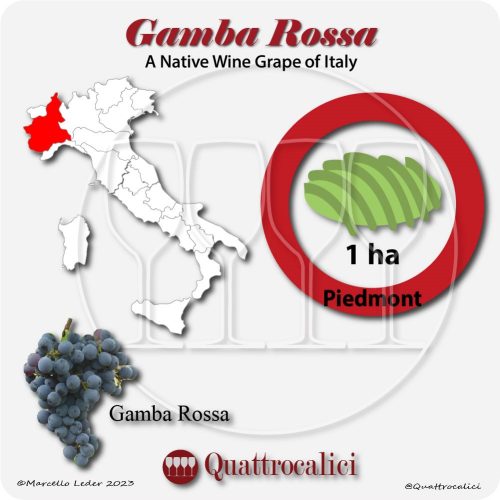


The Gamba Rossa grape variety is better known by its local synonym “Gamba di Pernice,” although the only officially recognized synonym is “Imperatrice dalla gamba rossa.” Gamba Rossa owes its unique name to the fact that the stem, before the onset of veraison (the coloring of the grapes that precedes ripening), is a bright red color and resembles the legs of partridges, which populate the vineyards during that period. Gamba Rossa is still often present on its own rootstock, having miraculously survived the phylloxera disaster that wiped out many other varieties at the end of the 19th and beginning of the 20th centuries. It is a grape variety that has always been present among the rows in the municipality of Calosso and the neighboring municipalities of Costigliole d’Asti and Canelli, all in southern Asti, and it was at risk of extinction before being “rediscovered” and revived just over ten years ago.
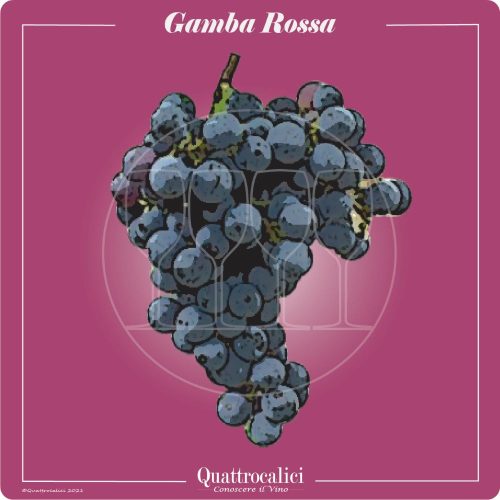
It has been included in the national register of grape varieties since 2007. Ampelographically, the Gamba Rossa grape variety has medium-sized, pentagonal, seven-lobed leaves. The cluster is medium-sized, pyramidal, with one or two well-developed wings, and compact. The berries are medium-large or large, spheroidal, very pruinose, blue-black with violet hues. Its ripening period is from late September to early October. The Gamba Rossa grape produces a wine with a medium garnet red color. On the nose, it is intense, spicy, and balsamic, with notes of green pepper and other oriental essences, fruity with predominant notes of jam and cherry in spirit. On the palate, it is dry, full-bodied, rightly tannic, often with a strongly mineral finish, with the return of the spicy sensations detected on the nose.