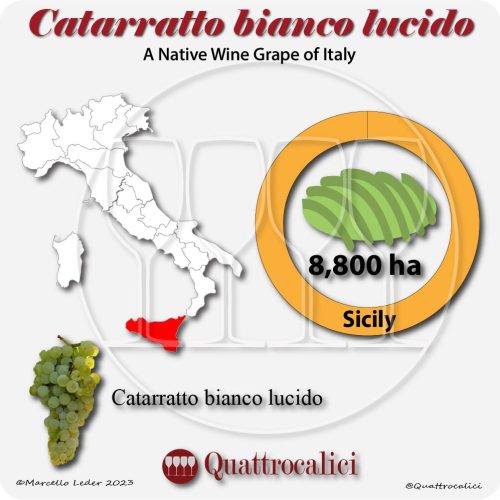


The Catarratto grape has been cultivated for centuries in Sicily, with its origins lost in the mists of time, making it one of the oldest on the island. The first written records date back to 1696, but it wasn’t until 1970 that a distinction was made between four different varieties of Catarratto: Catarratto Comune, Catarratto Lucido Spargolo, Catarratto Lucido Serrato, and Catarratto Lucidissimo or Extra Lucido. In fact, only two varieties are officially cataloged: Catarratto Bianco Comune and Catarratto Bianco Lucido. In its various forms, Catarratto today represents over 30% (approximately 30,000 hectares) of Sicily’s vineyard area, is part of the ampelographic base of numerous DOP wines (e.g., Sicilia, Alcamo, Marsala) and IGP wines, and is among the most cultivated grape varieties in Italy.
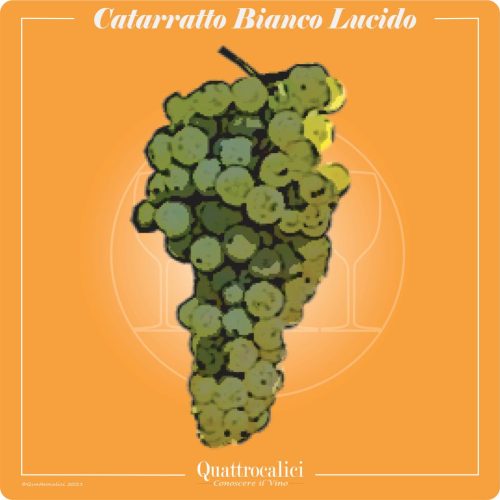
Catarratto Bianco Lucido has similar vigor, productivity, and training characteristics to Catarratto Bianco Comune. It has a medium-large, long, winged, cylindrical-conical, compact cluster with medium-small to medium berries, slightly pruinose, spheroid or elliptical, green-gray in color with golden hues on the sun-exposed side. When vinified as a single varietal, Catarratto Bianco Lucido has a straw-yellow color that tends towards golden. On the nose, it is fruity and slightly floral, with aromas of honeysuckle and citrus, particularly lemon, on a background of aromatic herbs. On the palate, it is very alcoholic and structured, with a flavor that is not particularly incisive, yet presenting notable freshness and a certain acidity.