


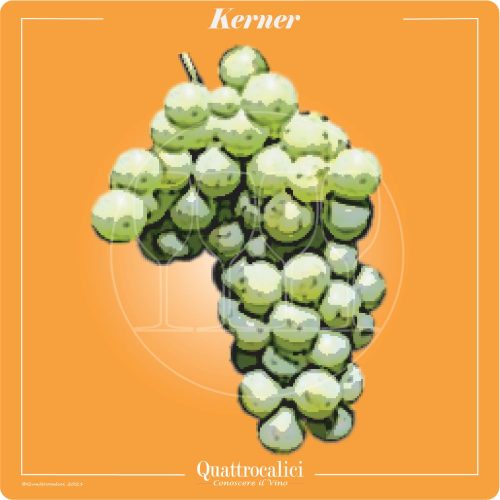
Kerner is an aromatic white grape variety created in 1929 in Germany. The botanist August Herold crossed Schiava Grossa (known in Germany as Trollinger) and Riesling, obtaining Kerner, which was named in honor of Justinus Kerner, a German physician and poet known for writing poems about wine. Kerner is similar to Riesling in aromas, with an added vegetal note that makes it slightly rougher. Kerner has late budding, making it less susceptible to spring frosts. When cultivated on sufficiently sunny slopes, it can reach altitudes of up to 8-900 meters above sea level, making it particularly suited to mountain viticulture. For this reason, it thrives in regions like Trentino-Alto Adige, Germany, and Austria, where it is still predominantly grown and appreciated.
In Italy, it is found in South Tyrol, especially in the Val d’Isarco, where the related wine obtained Denomination of Controlled Origin (DOC) status in 1993. Its intrinsic acidity makes it suitable for sparkling wine production, which, being an aromatic grape variety, is mostly done using the Charmat method. Kerner has a medium-small, five-lobed leaf, with a short, medium-small, and appropriately compact cluster. The berries are spherical, with thin and tender skin, of a beautiful green-yellow color. It is a very vigorous grape variety, requiring careful green harvesting. The Kerner grape prefers cold climates and good altitudes (800-900 meters), typical of central Europe and northern Italy, characterized by significant temperature variations, and it also adapts very well to soils of different origins and natures.
