


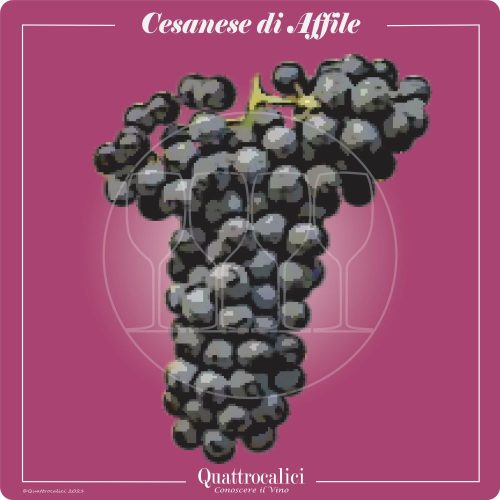
The Cesanese di Affile grape has uncertain origins. The origin of its name seems to derive from Cesano, a locality near Rome, although another theory connects it to the Latin word “Cesae,” meaning “place of cut trees,” as it was cultivated on hills cleared of woods. There are two distinct grape varieties called Cesanese, both extensively cultivated in Lazio and particularly in the area of the Castelli Romani: Cesanese di Affile and Cesanese Comune. Additionally, as often happens, the name of the grape is confused with that of the wine, so “Cesanese di Olevano Romano” and “Cesanese del Piglio” are often cited as “grape varieties,” which are actually types of wine with denomination of origin, respectively DOC and DOCG. The origins of Cesanese di Affile date back to very ancient times, already described by Pliny the Elder as belonging to the group of “alveole” present at that time in the area of Ariccia and used in large quantities for red wine production. Acerbi described Cesanese as a productive and high-quality grape, while Di Rovasenda mentioned it as Cesanese Nero.
Cesanese di Affile has smaller leaves and bluish-black berries compared to Cesanese Comune, and the wines produced from Cesanese di Affile are generally more complex and long-lived. The cluster of Cesanese di Affile is medium-sized, cylindrical-conical, winged, and moderately compact. Its berry is medium-small, oval-shaped, with a thick and firm skin, very pruinose, and violet-black in color. The harvest of Cesanese di Affile generally takes place in the first half of October. It is a grape variety that does not favor high altitudes and requires good sun exposure due to its challenging ripening process.
